Getting to Fuvahmulah: A Diver's Travel Guide
The journey from your home airport to a tiger shark briefing in Fuvahmulah involves three flights, one currency, and a few unwritten rules. Here's how to make it painless.

The first time anyone tells you Fuvahmulah is "in the Maldives," there's a quiet assumption that goes with it: a short hop, a sandy runway, a ten-minute speedboat. The reality is a little longer and a lot more interesting. Fuvahmulah sits 470 kilometres south of Malé, alone in its own atoll, a single inhabited island straddling the equator. Getting here takes planning. It also rewards it.
This guide walks you through the journey end to end — from your home airport to the moment a divemaster greets you at FVM with a clipboard and a smile.
The route at a glance
Your trip almost always looks like this:
- Your home city → Malé (MLE), the international hub
- Overnight or same-day connection in Malé
- Malé → Fuvahmulah (FVM) on a domestic Maldivian flight, ~1h 15m
- Airport pickup by your dive centre or hotel
The whole thing is one ticket if you book the international and domestic legs through the same agent, but most divers book them separately to keep flexibility on the Malé side. We'll come back to that.
Step 1 — Getting to Malé
Velana International Airport (MLE) is the only international gateway to the Maldives. From Europe, you'll usually transit through the Gulf — Dubai, Doha, or Abu Dhabi all have multiple daily flights. From Asia, direct service runs from Singapore, Bangkok, Kuala Lumpur, and Colombo. North American routings almost always involve the Gulf as well.
A few things worth knowing before you book:
- Arrive in Malé in daylight if you can. The domestic terminal is a short walk from international, but it's a busier, smaller space — easier in daylight, especially when you're herding a dive bag.
- Watch the date line. Most long-haul flights from Europe land in Malé before sunrise. You'll feel like you've arrived a day early. You haven't.
- Pack dive computers in your carry-on. Lithium batteries don't ride in checked luggage on most carriers, and a missing computer is the one piece of kit hardest to replace locally.
Most divers underestimate how much rest the equator costs you. Build in a recovery night — either in Malé or on Fuvahmulah before your first dive day. Your nitrogen loading will thank you.
Step 2 — The Malé connection
Here's where divers split into two camps.
Same-day connection
If the Maldivian schedule lines up, you can land in Malé and continue to Fuvahmulah the same morning. This is the fastest route but also the riskiest — if your international flight is delayed, you'll miss the domestic and lose a dive day rebooking.
Overnight in Malé (recommended)
Spend a night near the airport in Hulhumalé, the reclaimed island connected to MLE by a short causeway. Most airport hotels run a free shuttle. You'll get a proper sleep, time to rebalance your luggage between checked and carry-on, and a 6 AM domestic departure feels civilised instead of brutal.
A few hotels we hear about from guests regularly: airport-adjacent places in the Hulhumalé Phase 1 area are quiet at night and let you walk to the domestic terminal in the morning if you travel light.
Step 3 — Malé to Fuvahmulah
The domestic leg is operated by Maldivian (the national carrier). Flight time is 1 hour 15 minutes in an ATR turboprop. There are typically two to three flights a day, but the schedule shifts seasonally — always confirm 72 hours out.
What to expect on the flight
- 20kg checked baggage is the standard allowance. Dive bags usually exceed this. Pre-pay an excess baggage allowance online before you fly — it's cheaper than at the counter, and the counter sometimes refuses oversized bags at boarding.
- A snack and water are served. That's it. Eat in Malé.
- The window seats on the right side (rows in the high single digits) give you the best chance of spotting Huvadhoo Atoll on the way down — keep the camera handy.
Landing at FVM
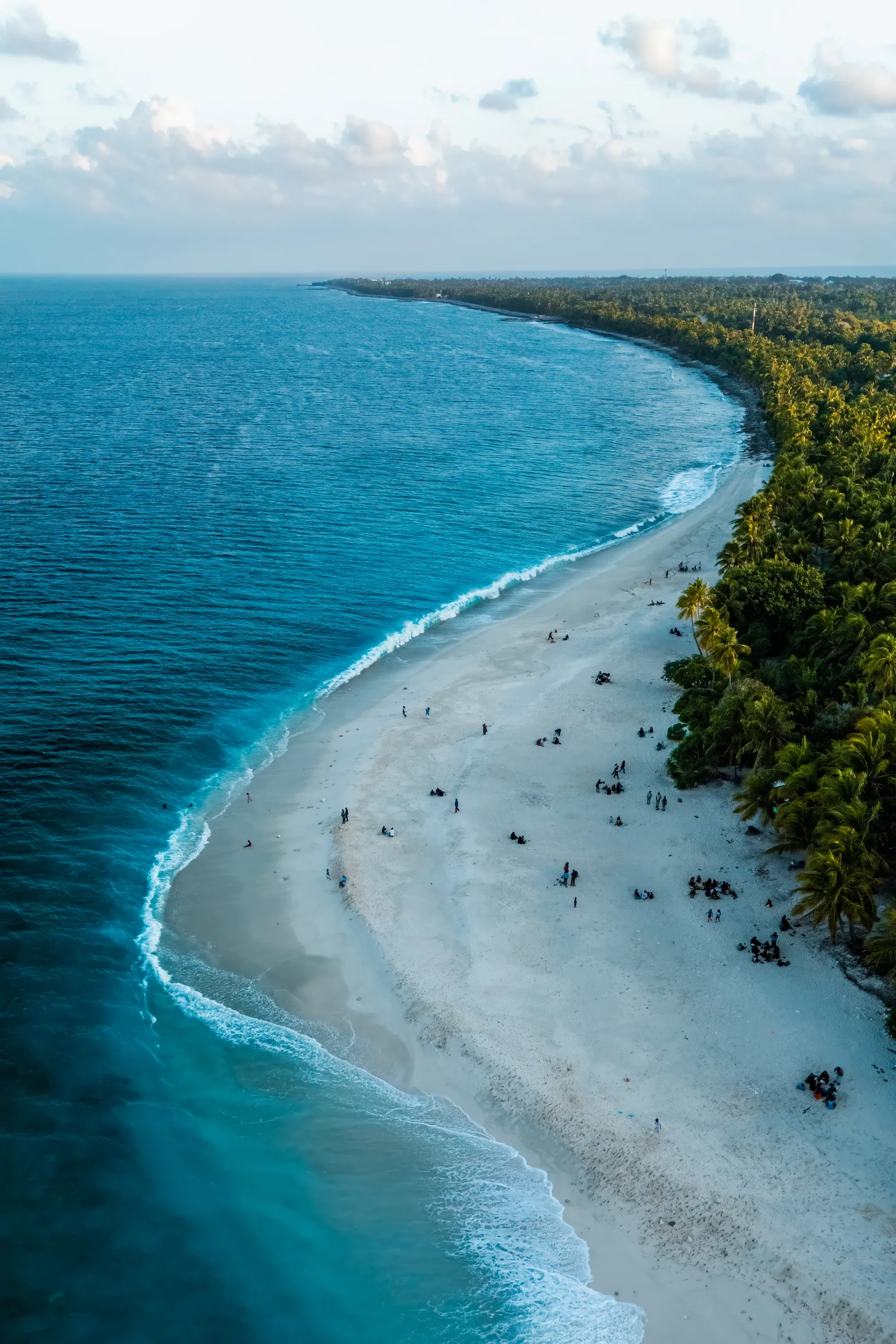
Fuvahmulah Airport is a single strip running almost the full length of the island's western side. The approach skims the lagoon; landing rolls past a beach you'll be diving from within 24 hours. The arrivals hall is one room with a single luggage carousel — bags appear within ten minutes.
Step 4 — Pickup and the first 24 hours
Your dive centre or hotel will have someone waiting for you at the arrivals exit. The drive to most accommodation on the island is 5 to 15 minutes. There's a single ring road, mopeds outnumber cars, and the whole place feels like it ends just as you've finished unpacking.
Use the first afternoon to:
- Drop your kit at the dive centre for a fit check. Tanks, weights, and rental gear are all sized up before your first dive — getting this done the day before saves morning chaos.
- Walk the harbour. Most diving operates from the harbour wall; knowing the layout helps when you're carrying gear in pre-dawn light.
- Sleep. You earned it.
A few unwritten rules
After hundreds of trips like this, the things divers most often wish they'd known sooner:
- Don't bring brand-new dive gear to test here. Tigers do not care about your warranty. Bring kit you trust.
- The currency you'll actually use is USD. Maldivian rufiyaa is the local currency, but USD is widely accepted and easier to manage.
- Mobile data works fine. Pick up a Dhiraagu or Ooredoo SIM at MLE — both have 4G across Fuvahmulah and the data is cheap.
- Tipping is appreciated, not expected. Divemasters work hard; cash at the end of your trip is the norm.
The way back
The return journey is the same in reverse, but plan for one extra buffer: leave at least 18 hours between your last dive and your international flight. Two domestic legs and a long-haul home is no time to risk a borderline nitrogen profile.
If you want help piecing together flights, hotels, and dive days into one itinerary, our team handles trip planning end-to-end — reach out via the contact page and we'll build a quote that includes everything between your home airport and the harbour wall.