Cage-Free Tiger Shark Diving: How Fuvahmulah Does It
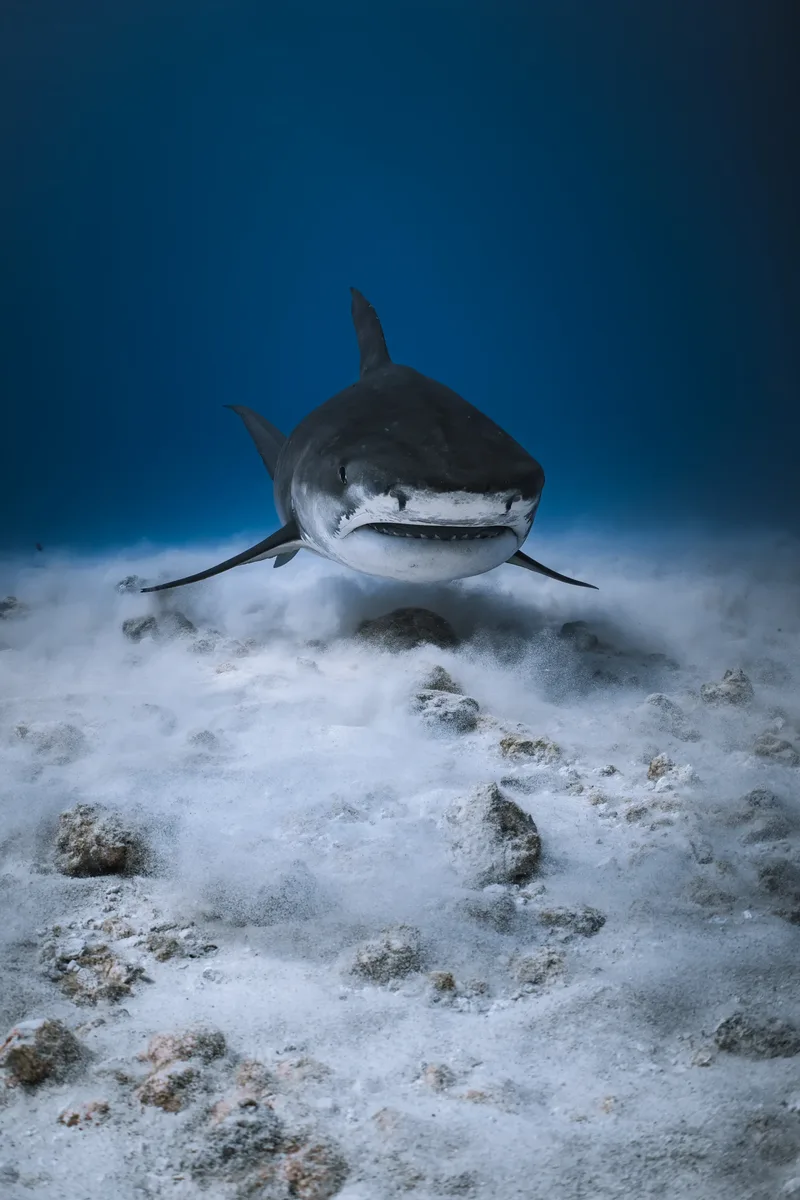
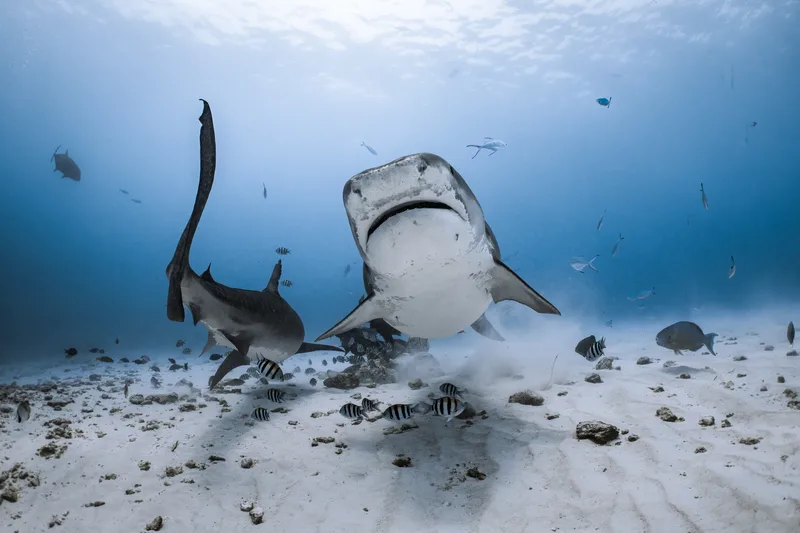
There is no cage on a Fuvahmulah tiger shark dive — and there never has been. You kneel on a sandy plateau at 6–8 meters, in open water, while tiger sharks pass within meters of you.
Cage-Free Tiger Shark Diving: How Fuvahmulah Does It
There is no cage on a Fuvahmulah tiger shark dive — and there never has been. You kneel on a sandy plateau at 6–8 meters, in open water, while tiger sharks pass within meters of you. Tiger shark diving without a cage isn't a stunt here; it's the island's standard, proven over thousands of dives. What replaces the cage is a system: shark behavior that's understood, a protocol that never varies, and trained safety divers holding the edges of the encounter.
If you've only ever seen shark diving through cage bars — great whites off South Africa or Guadalupe, baited cage drops elsewhere — the idea of "no cage, tiger sharks, come on in" sounds either fake or reckless.
It's neither. Here's why this works, and why the cage was never the thing keeping anyone safe anyway.
What a cage is actually for
A cage does one job: it manages an encounter nobody can otherwise control — typically fast, ambush-style predators in open blue water, drawn in by bait, in conditions where a diver can't read or respond to the animal.
Fuvahmulah's tiger dive is the opposite situation on every axis:
The sharks are known. These aren't transient animals passing through. Fuvahmulah's tigers are resident — the same individuals, encountered daily, with personalities our guides know like colleagues. Predictability is the first layer of safety, and it took this island years of consistency to build.
The behavior is calm. Fuvahmulah's tigers are slow, deliberate investigators. They approach in wide arcs, they observe, they move on. The frenzy you're imagining doesn't happen here — the protocol exists precisely to make sure it never starts.
The setting is controlled. Shallow. Bright. Sandy bottom, clear sightlines, a fixed formation of divers. Nobody is bobbing in murky blue hoping for the best. The site is practically an amphitheater — and everyone knows their seat.
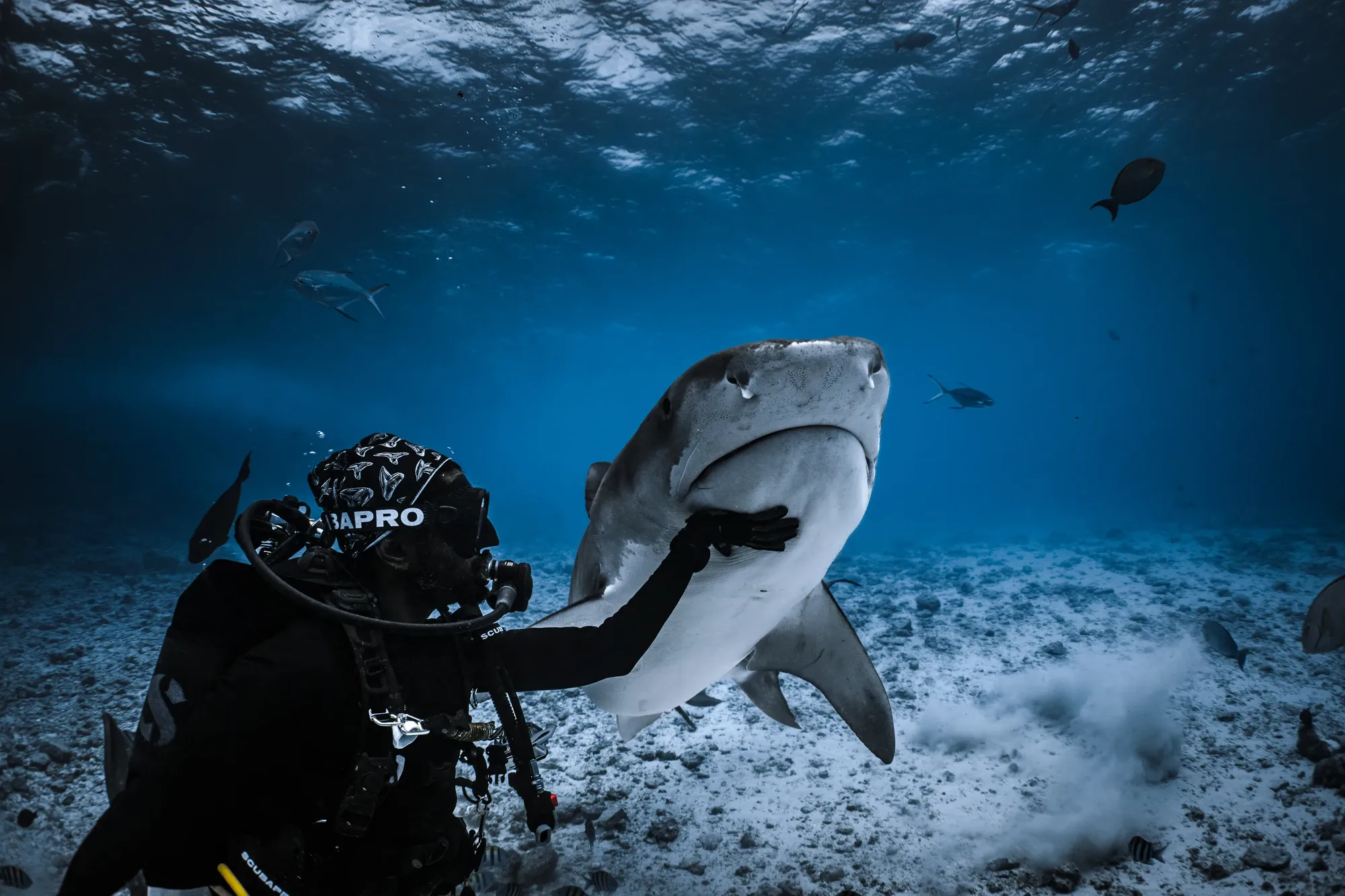
The humans are managed. This is the part visitors underestimate. Cage-free works because diver behavior is controlled: stay low, stay in line, eye contact, no touching, dark colors, follow the guide. A cage contains the human as much as it blocks the shark. Here, the briefing is the cage.
The invisible architecture of the dive
Watch a Fuvahmulah tiger dive from the outside and it looks almost casual. It isn't. Everything is choreography:
The entry is structured, not a splash-party. The line of divers forms low on the sand, guides anchoring the formation. Our safety divers position themselves where the angles need covering — watching the sharks you're not watching, doing the invisible work of moving someone a meter left before it matters, reading a shark's line three seconds early.
The provisioning is minimal, consistent, and controlled — non-live, natural bait only, never hand-feeding — enough to structure the encounter, never enough to change what these animals fundamentally are. Same rhythm, every day. The sharks know the routine better than the guests do.
And the ratio — one professional per three guests, maximum — means every diver is inside somebody's attention at every moment. That's the real cage: a lattice of experienced eyes.
Why no cage is actually the point
Here's what surprises people: cage-free isn't a compromise we make to feel brave. It's the entire reason the encounter transforms people.
Through bars, a shark is a spectacle — something happening at you. In open water, at eye level, it becomes a meeting. The shark sees you. You see it seeing you. There's a mutuality in it that no cage encounter can produce, and it's precisely that mutuality that dissolves thirty years of inherited fear in about four minutes of a first dive.
You can't fall in love through a fence.
And people protect what they love — which is why cage-free, done ethically, is one of the strongest conservation tools this island has. Every diver who kneels on that sand becomes someone who talks about tiger sharks differently for the rest of their life. That's the mission, in one dive.
What cage-free is NOT
Let's be equally honest in the other direction, because this model gets abused elsewhere:
It is not a free-for-all. Swimmers chasing sharks for selfies, operators cramming twenty divers onto the sand, bait-heavy circus shows — that's not cage-free diving, that's protocol-free diving, and it's how good records end.
It is not for every diver on every day. We assess honestly, and we say no when no is the right answer.
And it is not something to shop for on price. If an operator's cage-free dive is cheap because the safety layer is thin, the thing being discounted is you. (The questions worth asking any operator are here.)
FAQ: cage-free shark diving
Why don't you need a cage for tiger sharks in Fuvahmulah? Resident, well-understood sharks with calm investigative behavior + a shallow controlled site + strict diver protocol + dedicated safety divers. The system replaces the cage — and has kept Fuvahmulah's record clean: no fatal shark incident, ever.
Is cage-free diving legal and regulated? Yes — shark diving is central to Fuvahmulah's economy and identity, and the island's operators protect the protocols that protect the record. Sharks have been protected in Maldivian waters since 2010; the whole model depends on them thriving.
Do tiger sharks ever get too close? They sometimes pass within a meter — that's a normal investigation, not an incident, and your guides manage spacing continuously. "Too close" is exactly what the formation and the safety divers exist to prevent from ever becoming a question.
I've done cage diving with great whites. How does this compare? Completely different animal — literally and emotionally. Most guests who've done both tell us the same thing: the cage dive was exciting; this one changed them. What the tiger dive includes and costs is here.
Curious what open water and a tiger shark feel like with a proper team around you? Ask us anything about how the dive is run — protocol details are our favorite topic. Message us →
Liquid Shark Divers is Fuvahmulah’s premium shark diving center and creative dive hub — small groups, uncompromising safety standards, and encounters that change how people see sharks. Meet the team →