How to Choose a Dive Center in Fuvahmulah: 12 Questions to Ask Before You Book
The best dive center in Fuvahmulah is the one that can answer twelve specific questions without flinching — about safety ratios, group sizes, insurance, and what happens when something goes wrong.
How to Choose a Dive Center in Fuvahmulah: 12 Questions to Ask Before You Book
The best dive center in Fuvahmulah is the one that can answer twelve specific questions without flinching — about safety ratios, group sizes, insurance, and what happens when something goes wrong. This island now has many operators, prices vary, and from a website everyone looks professional. The differences show up in the water.
You're planning to share the ocean with 4-meter tiger sharks. This is exactly the trip where choosing on price alone is a mistake — and where the right questions protect you better than any review score.
Ask every center you're considering these twelve. Including us.
The safety questions (ask these first)
1. How many guests per guide on the tiger dive? This is the single most revealing number in Fuvahmulah diving. A 1:3 ratio means someone is actually watching you. A 1:8 ratio means you're watching yourself. If the answer is vague — "it depends on the day" — that's your answer.
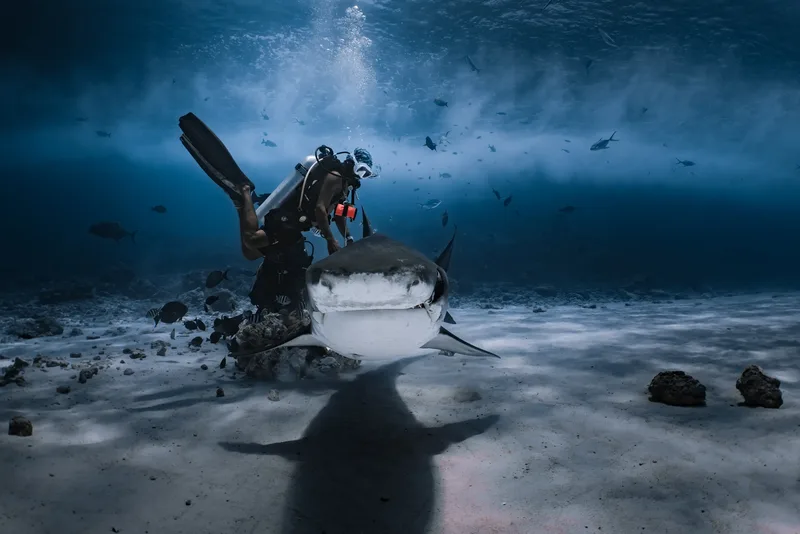
2. Are there dedicated safety divers in the water — and how many? Not guides who also carry a camera and also manage the group. Dedicated eyes whose only job is the edges: the shark behind you, the current, the diver drifting. Here's what that system looks like in practice.
3. How big is the group on the tiger dive? Twenty divers kneeling shoulder-to-shoulder changes shark behavior, ruins the encounter, and divides attention. Small groups aren't a luxury preference — they're a safety architecture and the difference between an encounter and a crowd scene.
4. What's the emergency plan? Oxygen on the boat? A spare tank rigged as a drop tank for deep dives? Team trained in first aid, CPR, AED? Can they recite the evacuation chain — harbour, island hospital, recompression chamber in Malé — without checking? You want the answer to sound boring and rehearsed. Boring and rehearsed is what saves lives.
5. Do they require or recommend dive insurance? A center that shrugs at insurance is telling you how seriously they take the day everything goes wrong. (We recommend DAN to every guest, and you can add it from $19 when booking.)
The experience questions
6. How long is the briefing — and what's in it? Fuvahmulah's tiger protocol is unlike any other shark dive on Earth. If the briefing is five minutes of "stay behind the line, have fun," keep looking. You should come out of a briefing knowing what the sharks will do, not just what you should do.
7. Who are the guides — and how long have they read these specific sharks? Tiger sharks here have individual personalities; experienced local guides know who's bold today and who's circling differently. That knowledge takes thousands of dives to build. Ask how long the team has been in this water — and ask what they're qualified to teach: every guide on our team is a certified instructor, not just a guide. Ours introduce themselves here.
8. What happens when conditions aren't right? The honest answer sometimes is: we adjust, we delay, we cancel. A center that never cancels anything isn't lucky — it's flexible about the wrong things. Ask what their no-go criteria are. If they can't name any, they don't have any.
The trust questions
9. Is the pricing transparent — all of it? Full price list published? Extras itemized? Or does the total grow after you've arrived? (Here's our complete cost breakdown — every number, including the ones nobody advertises.)
10. How do they handle the sharks themselves — and conservation? Provisioning protocol: controlled and consistent, or a show? No-touch rules enforced, or bent for content? A center's conservation practice tells you whether they see the sharks as partners or props. The sharks made this island's name; how an operator treats them is how they'll treat everything else.
11. What do recent guests actually say? Read past the star rating into the text: do reviews mention feeling safe, briefings, small groups, names of guides? Those specifics are hard to fake. Ours are public everywhere: 5.0 on Google across 43 reviews, 5.0 on Tripadvisor, and collected on our site — at the time of writing, not a single rating below five stars, and we know every guest behind them.
12. Do they ever say no? Ask what would make them refuse a guest a dive. The right answer exists and is delivered without embarrassment: not enough control in the water, ignoring the briefing, wanting to touch wildlife. A center that takes everyone, always, is optimizing for revenue — not for the person asking.
The honest meta-question
Notice what these twelve have in common: none of them is "what's your price?"
Price matters — but in Fuvahmulah the price differences between operators mostly are the answers to these questions. Ratios cost money. Safety divers cost money. Small groups cost money. Saying no costs money. When something is noticeably cheaper, one of these twelve is usually where the savings came from.
Choose the center whose answers you'd want to be true at 8 meters with a tiger shark behind you.
FAQ
Which is the best dive center in Fuvahmulah? The one that answers these 12 questions to your satisfaction — for your experience level, your comfort, your goals. We'd love it to be us, and we'll earn it in the answers, not claim it in a blog.
Are all Fuvahmulah operators safe? The island's collective record is strong — no fatal shark incident, ever — and everyone here works to keep it. But protocols, ratios and briefing culture genuinely differ between centers. That's exactly what the questions surface.
Should I book before arriving or choose on the island? Book ahead — high season sells out, and the good centers cap capacity on purpose. Walking in also means taking whatever group has space, rather than the setup you actually want.
Can I ask you these questions directly? Please do. Genuinely — WhatsApp us the whole list. Our favorite guests are the ones who interviewed us first.
Ready to interrogate us? Send the twelve questions — or your own harder ones — and we'll answer every single one, in writing, before you commit to anything. Start the conversation →
Liquid Shark Divers is Fuvahmulah's premium shark diving center and creative dive hub — small groups, uncompromising safety standards, and encounters that change how people see sharks. Meet the team →