Diving Fuvahmulah in Summer: The Low Season Secret
Tigers don't care about monsoon. Why Fuvahmulah's June–September low season delivers smaller groups, whale sharks, and the wildest light of the year.
Why Summer Is Fuvahmulah's Best-Kept Secret (And Why We Quietly Prefer It)
A founder's note from beneath the surface
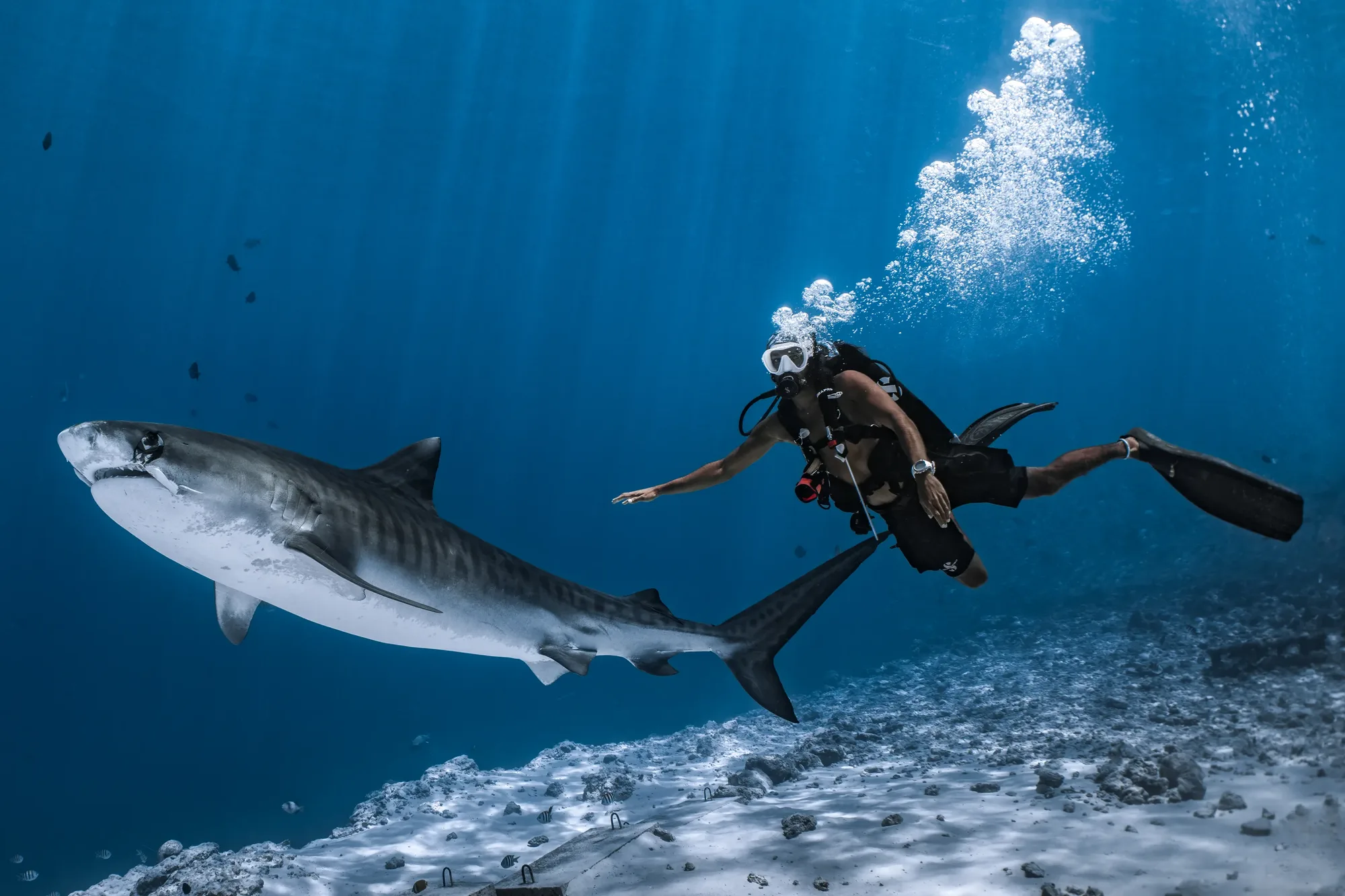
It's 7:12 AM on a Tuesday in July. The dhoni's engine has just dropped to idle. The water is darker than it looks in winter — a kind of green-blue that holds the light differently — and there's a tiger shark already circling below us, slow and unbothered, the way she always is. There are four divers on board. Not twelve. Four.
This is the season most operators warn you about.
It's also the one we quietly prefer.
The myth we don't bother correcting
If you've researched Fuvahmulah diving for June, July, or August, you've probably read the same thing on a dozen websites: "low season, reduced visibility, monsoon weather" The implication is always the same — wait for winter, get the real Fuvahmulah.
It's not wrong, it's just lazy.
The truth is more interesting. Summer here delivers things winter physically cannot — and most of the people who fly in during these months leave wondering why the rest of the world is asleep on it.
Let me explain what's actually going on under the surface from May to September. No sales pitch. Just what we see, dive after dive.
What actually happens at Tiger Point in July
Here's the thing about tiger shark diving in Fuvahmulah: the sharks don't read the weather forecast.
Our 300+ named resident tigers — yes, we know them by their markings, their personalities, their quirks — are here every single day of the year. Rain, sun, monsoon, dry season. They don't migrate. They don't disappear. They're residents.
In peak season (December through April), Tiger Point gets busy. The dive slot rotation system that keeps the site sustainable means more centers, more boats, more divers per slot. It still works beautifully — that's why the system exists — but it's just not as intimate.
In summer? The island goes quiet. Fewer operators are running full schedules. Fewer divers in the water over the course of a day, a week, a month. Which means when your slot comes up, you and your guide and your two dive buddies might be the only humans within sight of one of the most reliable apex predator sites on Earth.
That's not a downgrade. That's an upgrade most divers don't know they want until they've had it.
About the viz (let's be honest)
Is summer the best time to dive in Fuvahmulah? I'm not going to lie to you. Summer visibility in Fuvahmulah drops to roughly 15–25 meters, compared to the 30–40+ meters of February. That's the trade-off, and pretending otherwise would be insulting your intelligence.
But here's the context most people miss: 15–25 meter visibility is better than most Caribbean diving on a great day. It's better than 80% of the dive sites I've photographed around the world. It's not "bad viz." It's "not the absolute clearest water on the planet that month."
And for photography? It's the moodier, softer, more atmospheric light I sometimes find even more interesting to shoot than the sterile blue of peak clarity. The particles catch in the sunbeams. The water has texture. The shark emerges from the gloom instead of hanging in a fishbowl. As a photographer, summer Fuvahmulah produces some of my favorite frames of the year.
Different doesn't mean lesser. Sometimes different just means better for the story you're trying to tell.
Smaller groups, longer dives, more shark time
This is the part of the low season diving Maldives experience nobody markets, because it's hard to put on a brochure: when there are fewer divers, the math of your trip changes.
Our 1:3 guide-to-diver ratio is the strictest on the island regardless of season. But in summer, that ratio sometimes drops further on its own — not because we cut corners, but because the boats simply aren't full. You might end up with a private guide. You might end up as a two-person team with your photographer-partner and one of our most experienced shark safety divers.
You get more in-depth briefings. You get more questions answered. You get slower, deeper dives because nobody is rushing the schedule. And at Tiger Point, instead of sharing the 8-meter plateau with a nine other divers, you might share it with three.
I've watched guests in July float above the sand for fifteen straight minutes, motionless, while a six-meter tigress made unhurried passes within an arm's length. That doesn't happen in February. The pit is too crowded - even with our small groups - for that kind of private safety attention.
For the photographers among you
If you've been considering Fuvahmulah for an underwater photography trip — and given that you're reading this far, I'd bet you have — let me make a case I haven't made publicly before.
Summer is the photographer's season.
The light is softer and more directional. The water column is less disturbed by other divers. The plankton in the water makes for cinematic, depth-rich frames that flat-blue water cannot replicate. And the schedule flexibility lets us tailor dives more easily around the light — dawn for threshers, mid-morning for tigers when the angled sun cuts through the bloom, late afternoon at the southern reefs when everything turns gold.
I've shot Fuvahmulah in every month of the year. The images that have done the best for me are disproportionately from June, July, August. That's not coincidence. That's the light.
If you're a photographer planning a trip and the low season fits your calendar, I'd encourage you to take the slot. We run photography mentorships during these months and I have the time to actually work with you on the dhoni and in editing afterward, which I can't always promise in February.
The honest part: what summer doesn't give you
I'd rather lose your booking now than have you arrive with the wrong expectations.
Summer in Fuvahmulah means:
- Rougher seas on some days. Not unsafe — our 55-foot custom dhoni handles it — but if you're prone to motion sickness, bring patches just in case.
- Rain. Often warm, often passing in 15 minutes, but it rains.
- Wet gear that doesn't fully dry between dives sometimes. The dhoni has freshwater showers and we hang everything, but the air is humid. You learn to live with it.
- No hammerheads. They're mostly absent June through September. If hammerheads are your one true reason for coming, wait for October–April.
- Slightly lower visibility, which I've already addressed above.
What summer is not: dangerous, miserable, or empty of marine life. The tigers don't leave. The threshers don't leave. The mantas drop in when they feel like it. The reef is alive. The diving is still world-class. It's just a different flavor of world-class.
Who summer is actually for
Not everyone. I'm not going to pretend otherwise.
Summer in Fuvahmulah is for the diver who values intimacy over conditions. Who would rather have one private, quiet encounter than a dive with a small group of other divers. Who is comfortable enough as a diver that a little chop on the boat ride is part of the adventure, not a deal-breaker. Who understands that the real wildness of a place is what shows up when you stop trying to control the weather.
The water is wild and warm and full of life.
Frequently Asked Questions
Is it worth diving Fuvahmulah in June, July, or August?
Yes — especially if you value intimate dives, smaller groups — or even private dives. Visibility drops to 15–25 meters (still excellent by global standards), and tiger shark encounters at Tiger Point continue daily, year-round.
Are tiger sharks still in Fuvahmulah during monsoon season?
Yes. Tiger sharks are residents, not seasonal migrants. Our 300+ named individuals are present every day of the year regardless of weather. Tiger Point dives happen daily through summer.
What's the difference between summer and peak season diving in Fuvahmulah?
Peak season (December–April) brings the clearest visibility (30–40m+), the potential for hammerheads, and more divers on the island. Summer (June–September) brings smaller groups, whale shark and oceanic manta encounters during plankton blooms, softer light for photography, and easier last-minute booking. Both are world-class — they're just different flavors of it.
Is the weather too rough to dive in summer?
Some days are choppier than peak season, but the dives themselves are safe and consistent. Our 55-foot custom dive dhoni is built for these conditions. We recommend motion sickness medication if you're prone to it. Dive operations rarely cancel for weather alone — our boats run year-round.
Do prices change in low season?
Some package elements (like accommodation) are slightly more flexible in summer, but we don't run discount pricing. The value you get in summer comes from the experience — smaller groups, more attention, longer dive times — rather than a discount tag. We believe in transparent, year-round pricing that reflects what we actually deliver.