The Galapagos of the Maldives: Why They Call Fuvahmulah That
People have started calling Fuvahmulah the Galapagos of the Maldives. I understand exactly why the nickname exists — and why it only tells you half the story. Here's the honest version of both halves.
The Galapagos of the Maldives: Why They Call Fuvahmulah That
People have started calling Fuvahmulah the Galapagos of the Maldives — travel magazines, dive platforms, guests stepping off the plane with the phrase already in their mouths. As someone who photographs this island's water almost every day, I understand exactly why the nickname exists. I also think it only tells you half the story. Here's the honest version of both halves.
Where the nickname comes from
The Galapagos means one thing to most people: a small, remote place where wildlife is so concentrated, so unbothered and so present that it rewrites your sense of what's normal. You don't travel there for a chance at something. You travel there because life is simply around you, in a density that doesn't happen elsewhere.
That's the promise the nickname makes about Fuvahmulah. And on that promise, the island delivers.
This is one single island in the Maldives' deep south, near the equator, standing alone in open ocean. No atoll ring around it, no lagoon buffer — the deep blue starts at the reef's edge. And that geography is the whole secret: everything that travels the open ocean passes this one small place.
What one week here actually looks like
I'll give you the cast the way I'd give it to a guest on their first evening, honestly and without a single inflated promise:
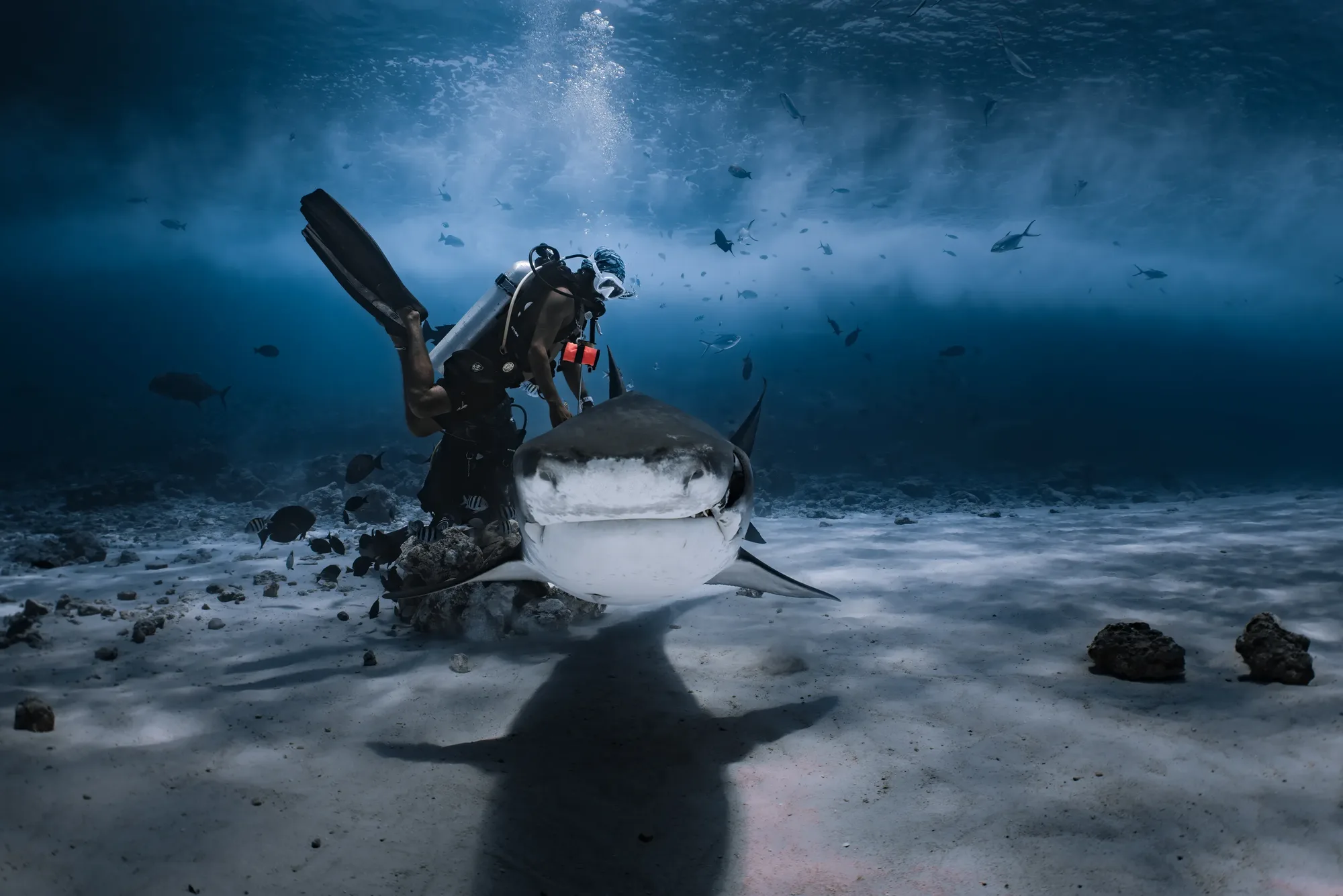
- Tiger sharks — every day. This is the fact that made Fuvahmulah famous, and it's the one thing I'll state as a certainty, because our dives show it daily: typically 4–10 tiger sharks on the plateau. Watching them never becomes routine. It becomes deeper.
- Thresher sharks — possible at dawn all year, at their best December to April. The most elegant animal I have ever pointed a camera at.
- Hammerheads — in season October to April, best chances at dawn, 20–30 m down in the blue.
- Oceanic mantas — peak March to May. Whale sharks — best odds February to April. Longimanus — seasonal. Silvertips and reef sharks are regulars all year.
Read that list again and remember it belongs to one island — the same harbour, the same week, sometimes the same morning. That's what people are reaching for when they borrow the Galapagos name. The marine life calendar breaks it down month by month, and if you want the science of why the tiger sharks are here in these numbers, we've written about that too.
Why does one small island hold this much life?
Stand on the shore and you're looking at open ocean in every direction. Fuvahmulah works like a crossroads: a lone landmark in deep water, where the pelagic travelers — the sharks, the mantas, the big ocean wanderers — come close enough to meet us. Most of the Maldives hides its sharks in channels and corners and hopes. Here, the ocean's traffic passes the front door.
As a photographer, this changes everything about how you work. You're not gambling a whole trip on one lucky pass. You're returning to the same animals, in the same light, morning after morning — which is the difference between taking a picture of a shark and building a relationship with a subject. It's why I can spend a week on one idea. It's why our dive sites feel less like locations and more like rooms in a house I keep coming back to.
Where the comparison falls short — honestly
I want to be straight about this, because we don't do inflated claims here: Fuvahmulah is not the Galapagos, and it isn't trying to be.
The Galapagos is an archipelago, a place people cross oceans to see landscapes and endemic species found nowhere else on Earth. Fuvahmulah is one tropical island you can walk across in an afternoon. If you arrive expecting giant tortoises and volcanic islands, you've read the nickname too literally.
What the comparison is really about is concentration — an unreasonable amount of life organized around one small, remote place. On that measure, the nickname fits. But here's my quiet objection to it: borrowed names always undersell the original thing. Nobody calls the Galapagos "the Fuvahmulah of the Pacific." Give it a few more years of divers coming home changed, and I don't think we'll need the borrowing either.
What the nickname misses entirely
Every version of the "Galapagos of the Maldives" story is about the animals. Fair. But the part I never see written about is what this density of life does to people.
When a tiger shark is not a once-in-a-lifetime jackpot but tomorrow morning's plan, something shifts in a diver. The adrenaline of day one becomes the attention of day three becomes something I can only call affection by day five. You start recognizing individuals. You stop photographing "a shark" and start photographing her. Fear turns into fascination, fascination into respect — and respect is where protection begins. Sharks have been protected in Maldivian waters since 2010; the guests who leave here become part of why that protection has a future.
That transformation is the real story of this island. The nickname gets people on the plane. The tiger sharks of Fuvahmulah do the rest.
Seeing it for yourself
We keep it simple and we keep it small — groups of usually 3–8 divers, every guide a certified instructor, dedicated safety divers on every tiger dive, no cages, no hand-feeding, no touching. The water is 27–29 °C all year; a 3 mm suit and curiosity are the equipment that matters. If you're a photographer, this is the most generous classroom I know — it's where I run my photography mentorships, because nowhere else gives you this many honest chances at the same subject.
FAQ: the Galapagos of the Maldives
Why is Fuvahmulah called the Galapagos of the Maldives?
Because of the concentration of large marine life around one small, remote island: daily tiger sharks, seasonal threshers, hammerheads, oceanic mantas, whale sharks and more — a cast that elsewhere would take several destinations to collect.
Is Fuvahmulah really like the Galapagos?
In density of wildlife, yes; in everything else, no — it's a single tropical island, not an archipelago of endemic species. The nickname is about how much life passes one place, not about similarity.
What animals can you see in Fuvahmulah?
Tiger sharks daily (typically 4–10 on a dive), threshers at dawn year-round with a December–April peak, hammerheads in season October–April, oceanic mantas peaking March–May, whale sharks best February–April, seasonal longimanus, plus silvertips and reef sharks regularly.
When is the best time to visit?
There's no wrong month — the tigers are here year-round. December to April stacks the most seasonal species on top. The marine life calendar shows the full picture.
Nicknames are invitations, and this one is honest enough. But the island doesn't need a borrowed name to change how you see the ocean — it just needs you in the water. If you're curious what your week here could look like, write to us. I'd love to show you what the nickname can't.
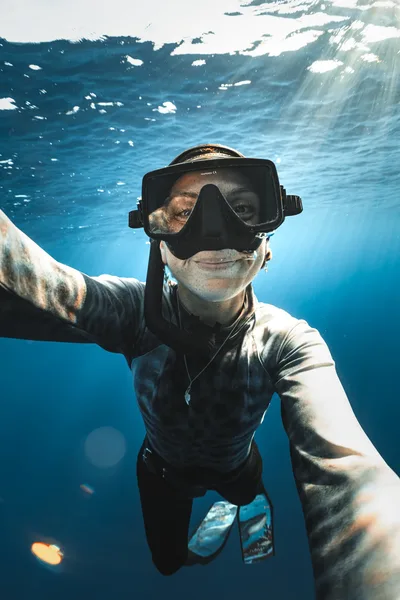
Sina Ritter is a multi-award-winning underwater photographer, storyteller and co-founder of Liquid Shark Divers — Fuvahmulah's premium shark diving center and creative dive hub. Join her photography mentorships →