Why Does Fuvahmulah Have So Many Tiger Sharks? The Science, Explained
Fuvahmulah hosts the largest known aggregation of tiger sharks on Earth — a fact confirmed by science, not marketing: a 2024 study in Nature Scientific Reports d
Why Does Fuvahmulah Have So Many Tiger Sharks? The Science, Explained
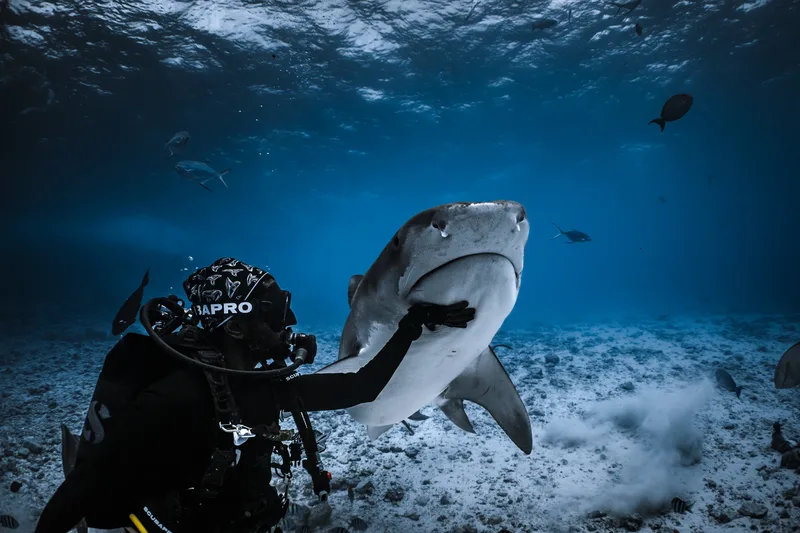
Fuvahmulah hosts the largest known aggregation of tiger sharks on Earth — a fact confirmed by science, not marketing: a 2024 study in Nature Scientific Reports documented over 200 individual tiger sharks at this single Maldivian island, the majority of them female. The reasons come down to three things: extraordinary geography, decades of fishing history, and a resident population that found every reason to stay.
Divers ask us this question weekly, usually around day two, once the daily reliability sinks in: how is this normal here?
So — why are there so many tiger sharks in Fuvahmulah? It's a fair question. Tiger sharks are typically wide-ranging, solitary wanderers — crossing oceans, appearing, vanishing. Aggregations this dense and this permanent essentially don't exist anywhere else. So let's take the question seriously and answer it properly.
Reason 1: the island is a geographic anomaly
Fuvahmulah isn't a normal Maldivian atoll. It's a single, isolated oceanic island — no lagoon, no barrier, no shallow sandy apron. One island, alone, rising from truly deep water in the channel between the Maldives' southern atolls, washed by open-ocean currents on every side.
For pelagic life, that makes the island a mid-ocean oasis: an abrupt wall where deep water, nutrients and prey concentrate. It's why the same small island produces threshers, hammerheads, oceanic mantas and whale sharks — the whole calendar of giants. Tiger sharks sit at the top of a food web that the geography itself keeps stocked.
A tiger shark cruising the Indian Ocean encounters Fuvahmulah the way a traveler encounters the only lit café on a long dark highway.
Reason 2: the harbor history
The second ingredient is human, and we tell it honestly.
Fuvahmulah is a fishing island — tuna above all; it's in the food, the culture, the harbor's daily rhythm. For generations, fish waste from the day's catch ended up near the harbor. Tiger sharks, intelligent and opportunistic, learned the schedule. Long before dive tourism, the sharks were already here — drawn by geography, kept by habit.
What changed is what the island did with that reality. Rather than a chaotic byproduct, the encounter became structured: managed provisioning at one site, consistent protocols, professional supervision. The dive the world now travels for — Tiger Harbour — is that history, disciplined into something safe, repeatable and genuinely respectful.
Is that "natural"? Here's our honest framing: the sharks' presence is natural — geography and prey brought them, and study after study shows tigers here continue their normal wide-ranging behavior, hunting and traveling as tiger sharks always have. The reliability of the meeting point is the managed part. What matters is that it's managed with restraint, consistency and the animals' welfare as the line that doesn't move. (How we hold that line, here.)
Reason 3: the ladies stayed
The 2024 research put a number and a structure to what the island's divers already knew: this is a resident population, dominated by large females — over 200 identified individuals, many seen again and again across years.
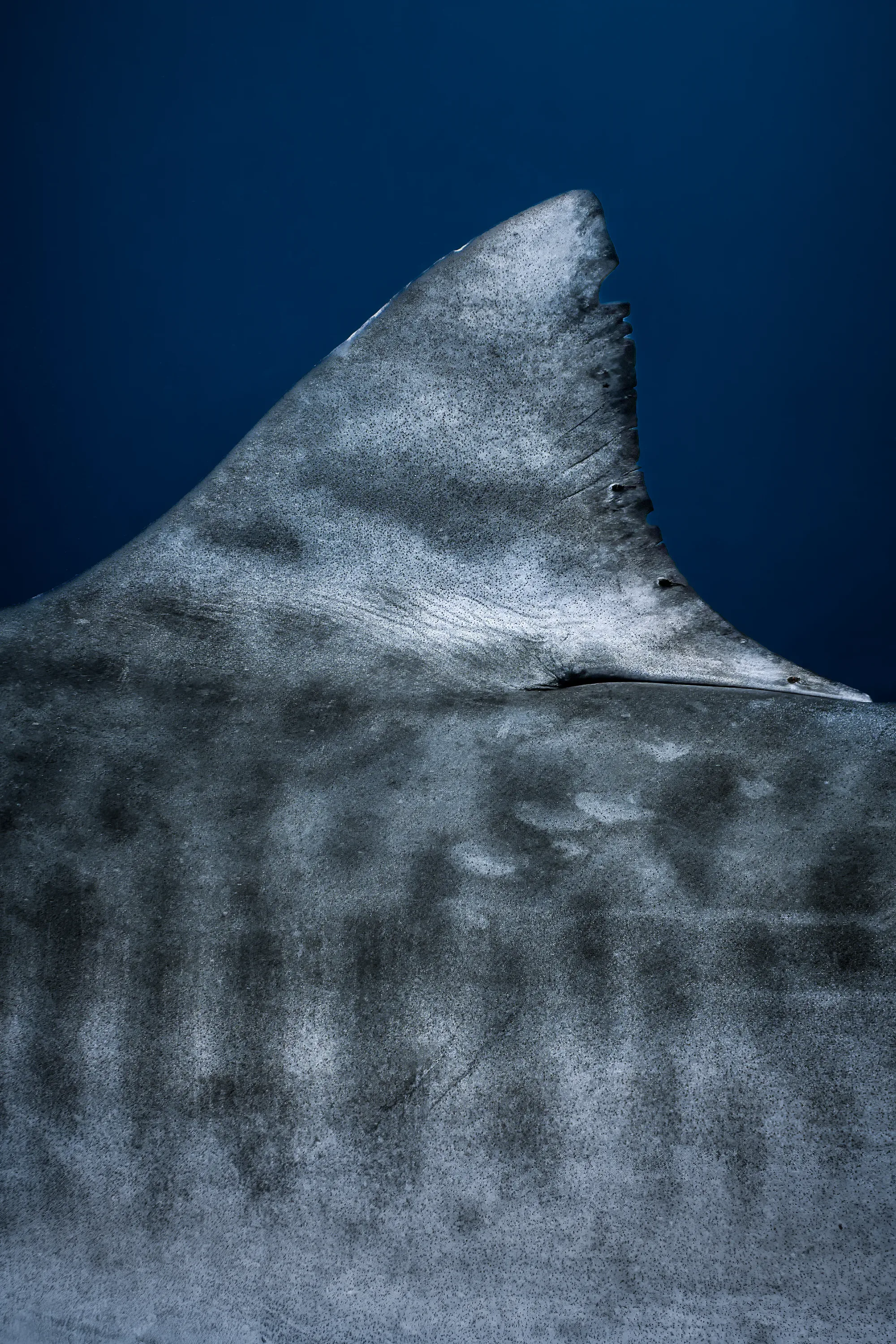
Why so many females? Research points toward the deep, warm, food-rich waters around the island suiting big female tigers — including, fascinatingly, pregnant ones. Our guides know dozens of individuals on sight: scar patterns, stripe fades, personalities. The bold one. The wide-circler. Some have been part of daily life here longer than some of our staff.
When an animal that can cross an ocean chooses to stay, it's telling you something about the neighborhood.
Why this matters beyond the wow-factor
For science: a dense, reachable, individually-identifiable tiger shark population is a research goldmine — photo-ID, behavior, population dynamics. Every documented dive adds data points. Guests regularly contribute IDs without realizing they're doing citizen science.
For conservation: sharks have been protected in Maldivian waters since 2010, and Fuvahmulah is the living proof of the economics: a tiger shark here is worth incomparably more alive — to the island, to the country, to the divers it transforms — than any alternative. The aggregation made this island a global argument for shark protection.
For you: it means the encounter isn't a lottery. It's the closest thing in big-animal diving to a promise — tigers on effectively every dive, year-round.
FAQ
How many tiger sharks are there in Fuvahmulah? Research published in 2024 identified over 200 individuals — the largest documented tiger shark aggregation in the world. On a typical dive you'll meet 4–10 of them; exceptional days bring 15+.
Is it the biggest tiger shark aggregation in the world? Per the published science, yes — nowhere else has a documented aggregation of this size and density. Famous sites like Tiger Beach (Bahamas) see far fewer individuals.
Are the sharks only there because of feeding? No — geography and prey explain the presence; the harbor history explains the habituation to one meeting point. Tagging and observation show these sharks continue normal ranging and hunting behavior. The provisioning structures the encounter; it doesn't sustain the population.
Why are most of them female? The current science suggests the conditions around Fuvahmulah — warm, deep, prey-rich — particularly suit large females, including pregnant ones. It's an active research question, and honestly one of the coolest open mysteries of this island.
Want to meet the study population in person? Come count stripes with us — and ask our guides about their favorite individuals; fair warning, they'll talk your whole surface interval. The tiger dive, explained →
Liquid Shark Divers is Fuvahmulah’s premium shark diving center and creative dive hub — small groups, uncompromising safety standards, and encounters that change how people see sharks. Meet the team →