Hammerhead Season in Fuvahmulah: October to April, at Dawn
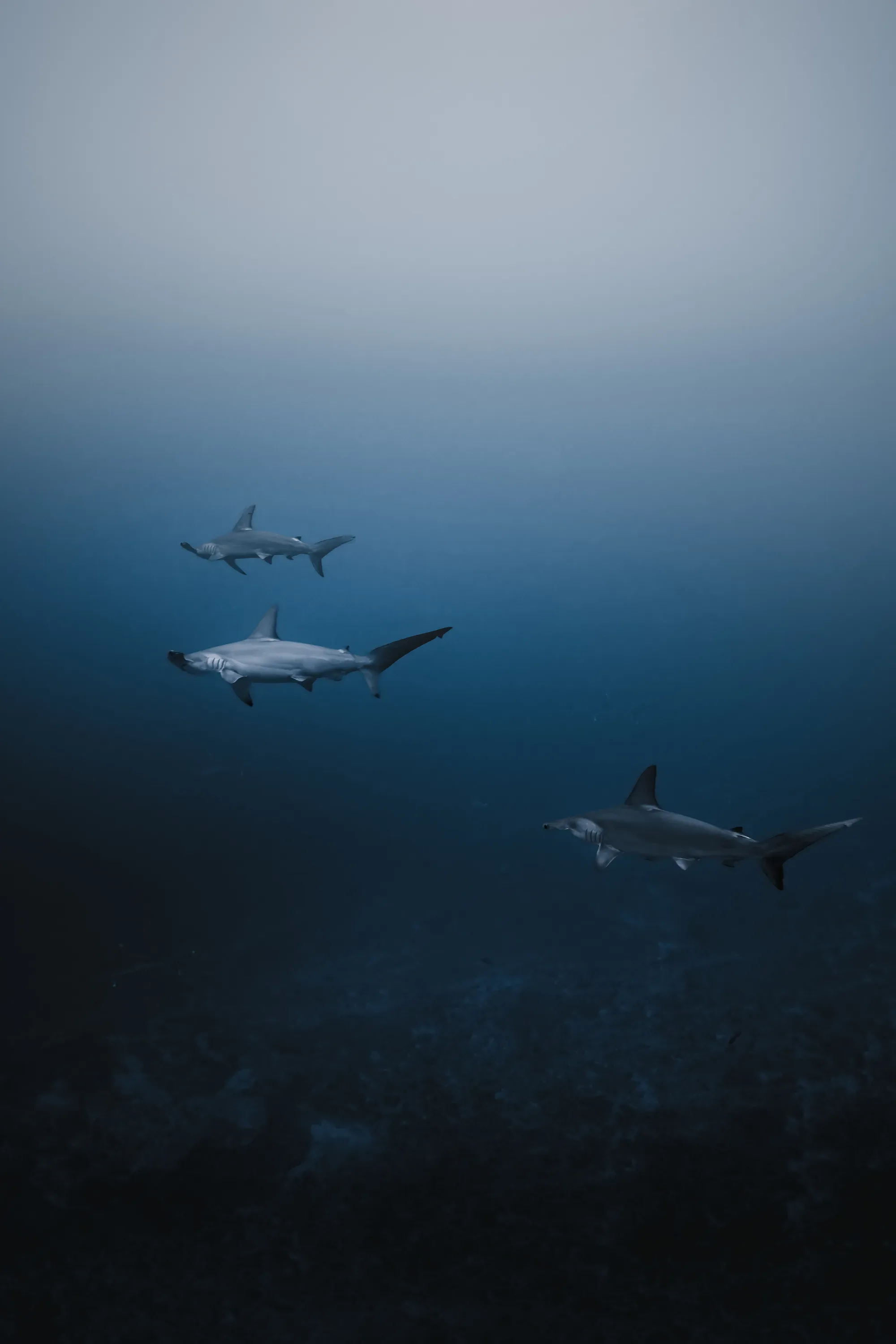
Hammerhead season in Fuvahmulah runs from October to April: scalloped hammerheads schooling at 20–30 meters on our deep dawn dives — typically 5 to 30 animals when the morning delivers.
Hammerhead Season in Fuvahmulah: October to April, at Dawn
Hammerhead season in Fuvahmulah runs from October to April: scalloped hammerheads schooling at 20–30 meters on our deep dawn dives — typically 5 to 30 animals when the morning delivers. It's the highest-potential hammerhead shark diving in the Maldives, the window opens every October, and it pairs with a fact no other hammerhead destination on Earth can offer: you'll dive with tiger sharks the same morning.
Here's how the season works, what the dive demands, and how to give yourself the best odds at one of diving's most hypnotic sights.
Key facts: Fuvahmulah hammerheads
- Season: October – April (peak of the cool, clear dawn months)
- Species: scalloped hammerhead (Sphyrna lewini) — Critically Endangered, and protected in Maldivian waters
- Depth: encounters at 20–30m; the thermocline typically sits at 18–25m
- School size: 5–30 animals; loners and pairs on quieter days
- Time: dawn — first dive of the day, always
- Level: AOWD minimum; the expert site Farikede is earned, not bought
- Insider truth: going deeper does NOT improve the encounter — patience at the right depth does
Why dawn, and why deep
Scalloped hammerheads spend their days in cooler, deeper water and rise along walls and points in the early hours. In Fuvahmulah, that means the alarm goes off dark, the boat leaves at first light, and you drop onto the deep side of the island while the surface is still turning silver.
The dive itself is a discipline of patience: descend to the working depth, settle along the wall at 20–30 meters, control your breathing, and watch the blue. Hammerheads reward stillness. A tense, chasing diver empties the ocean; a calm line of divers becomes part of the seascape, and the schools materialize — first as pencil strokes in the haze, then, on the good mornings, as a wall of that unmistakable silhouette.
About the thermocline — the honest local secret: the cool layer usually sits between 18 and 25 meters, and the sharks work its edge. Divers who bolt deeper "to get closer" find colder water, shorter no-deco time, and the same distance to the school. Stay at the right depth, be patient, let them come. Depth is not the currency here; calm is.
What "season" honestly means
October to April is when dawn schools become a regular pattern rather than a lucky morning — driven by the northeast monsoon's clear, settled conditions. Within the window, no wild animal signs a contract: some mornings deliver thirty sharks in formation, some deliver three, some deliver a thresher photobombing your hammerhead dive (a very Fuvahmulah problem to have).
That's also why we build hammerhead ambitions into a week, not a morning. Across five or six dawn dives in season, your odds move from "hopeful" to "strongly in your favor." The full species calendar shows how the hammerhead window overlaps prime thresher months — same dawn dives, double the reasons to set the alarm.
What this dive asks of you
We're straight about this: the hammerhead dive is the grown-up dive of the Fuvahmulah week.
Certification: AOWD minimum — encounters live below Open Water's 18m ceiling. If you're not there yet, we can complete your AOWD or Deep Specialty during your stay — the Deep Specialty is just 2 dives plus a short academic session, woven into your holiday.
Comfort in blue water and current. The deep side of an oceanic island is real ocean. Nothing here is extreme with our team beside you — group sizes stay small, ratios stay 1:3 — but honest self-assessment beats bravado. Tell us where you're at; we'll build your week in the right order, easier sites first.
Farikede — our legendary expert-level site — is the postgraduate version. Guides' call, conditions' call, your logbook's call. When it all lines up, it's the best morning of many divers' lives. Explore all 20 dive sites here.
The morning that makes the trip
Here's what a season dawn looks like with us: 5:30 coffee in the dark. Boat out as the island wakes. Drop into blue twilight, settle at 25 meters, six divers breathing slow. Twelve minutes of nothing — then the guide's rattle, two taps, and out of the gloom: fifteen scalloped hammerheads, stacked and swinging in formation, that alien head sweeping side to side.
Back on the boat by 7:30, ears ringing with silence. And your day has barely started — the tiger dive is at ten.
That double bill — hammerheads at dawn, tigers before lunch — exists nowhere else on this planet. October to April is when it's at its fullest.
FAQ: hammerheads in the Maldives
Where is the best place to see hammerheads in the Maldives? Fuvahmulah, on the deep dawn dives, October–April. The island's oceanic geography puts schooling scalloped hammerheads within recreational range — more on the species here.
How deep do you dive for hammerheads? Encounters typically happen at 20–30m. The thermocline sits at 18–25m and going deeper doesn't help — local knowledge and patience matter more than meters.
Can I see hammerheads and tiger sharks on the same trip? Same morning, in season. Dawn hammerhead dive, tiger dive mid-morning, reef in the afternoon — the standard Fuvahmulah triple.
How many hammerheads will I see? Schools of 5–30 on good season mornings. This is wild ocean, not an aquarium — across a week of dawn dives in season, most divers connect properly at least once, usually more.
Want this season's dawn dives? October–April weeks fill with exactly the divers who read articles like this one. Tell us your dates and your certification level — we'll tell you honestly what your mornings could look like. Check season availability →
Liquid Shark Divers is Fuvahmulah’s premium shark diving center and creative dive hub — small groups, uncompromising safety standards, and encounters that change how people see sharks. Meet the team →