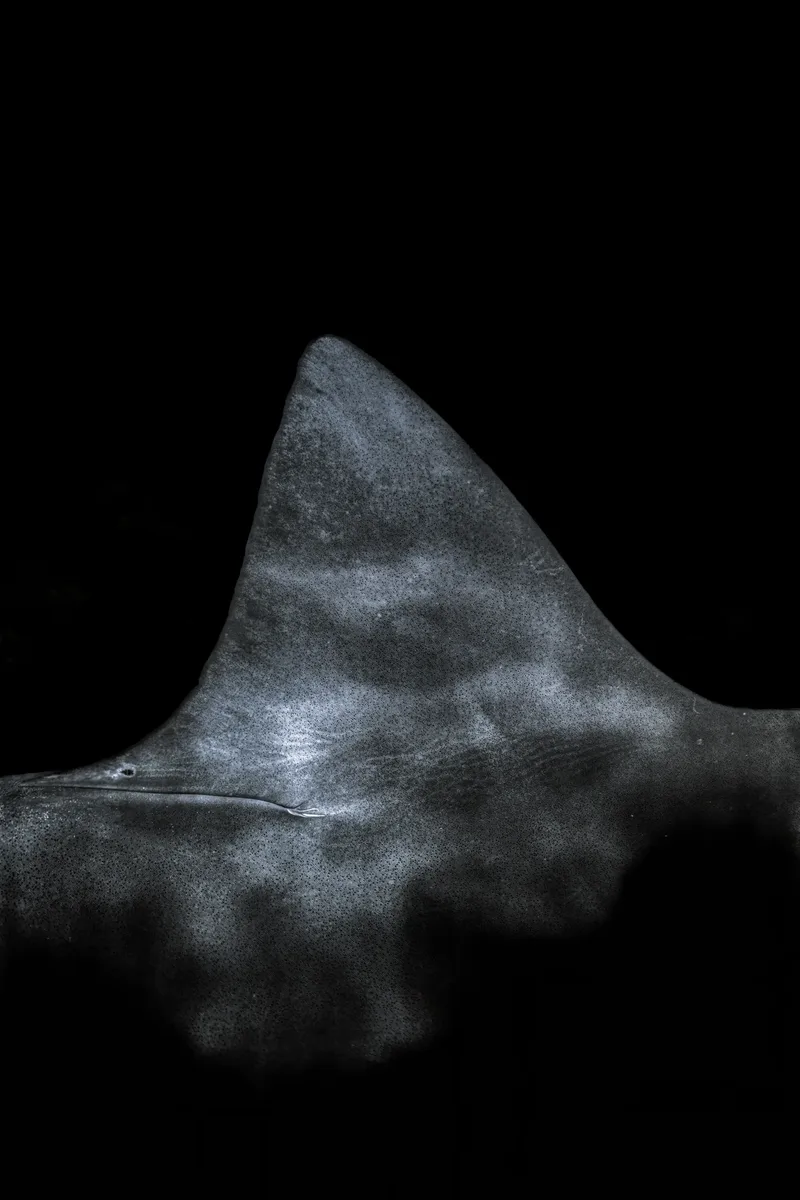
How to Overcome Your Fear of Sharks (What We Watch Happen Every Week)
The fastest way to overcome fear of sharks is the one almost nobody tries: meet one, properly, with professionals holding the frame. Education shrinks the fear,
How to Overcome Your Fear of Sharks (What We Watch Happen Every Week)
The fastest way to overcome fear of sharks is the one almost nobody tries: meet one, properly, with professionals holding the frame. Education shrinks the fear, understanding softens it — but in my years running tiger shark dives in Fuvahmulah, I've watched hundreds of frightened people kneel on our sand, and I can tell you where the fear actually dies: about four minutes into the first encounter.
If your fear is milder — you'd just rather not think about what's under you when you swim — this article still works. And if it has a clinical edge to it, there's a name for that, and a path.
First: your fear is normal, learned — and reversible
Fear of sharks even has a formal name: galeophobia. Here's the liberating part: almost nobody is born with it. It was installed — by a 1975 film score, by news coverage that reports every incident on Earth and none of the billions of peaceful ocean hours, by cartoons with dorsal fins. You learned sharks are monsters the same way you learned any other story.
What's learned can be unlearned. Not by force — by replacement. The brain doesn't delete fear; it overwrites fear with experience. That's the mechanism everything below uses.
Step 1: swap the story for the data
Fear feeds on vagueness, so give it numbers instead: roughly 60–70 unprovoked bites a year worldwide across billions of ocean users; divers barely represented in the statistics; the full honest data here. Meanwhile humans kill about 100 million sharks a year. Your amygdala won't be argued out of anything — but your rational brain needs this floor to stand on for the next steps.
Step 2: watch real sharks being real sharks
Not attack compilations — real footage of sharks doing what sharks do 99.99% of the time: cruising, being cleaned, ignoring divers. Watch tiger sharks moving like slow silk, threshers at cleaning stations, hammerheads schooling. Notice what your nervous system does after an hour of this: recalibrates. Boredom is the antidote to horror.
Step 3: understand them (this is where it flips)
Fear needs a monster; knowledge dissolves one. Learn how sharks investigate (slow arcs, not ambushes on divers), what their body language means, why a diver making eye contact is treated completely differently than a splashing silhouette. Guests who read our marine life calendar and species pages before arriving consistently have the calmest first dives — because nothing underwater surprises them. (We even teach a full SSI Shark Ecology course for exactly this.)
Step 4: the meeting
Here's what I watch from behind my camera, week after week:
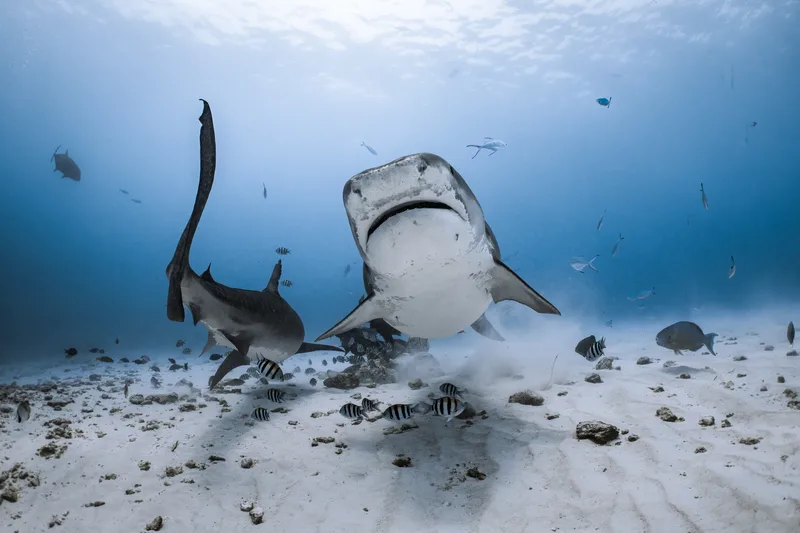
A guest descends with a heart rate you can practically hear. They kneel. The first tiger shark resolves out of the blue — and their whole body goes rigid. The shark approaches the way tigers here always do: unhurried, deliberate, one dark eye taking them in. It banks. It passes. It leaves.
And the diver's shoulders drop.
Second pass: their head tracks it with curiosity instead of terror. By minute ten they've stopped gripping their knees. By minute thirty — every time, and I mean every time — I watch a person fall quietly in love with the exact animal they'd feared for thirty years. On the boat they can't stop talking. That night they message everyone they know.
Fear wasn't argued away. It was replaced — by an experience too vivid and too beautiful for the old story to survive. This is the dive where it happens.
If your fear is the serious kind
Genuine galeophobia — panic attacks, avoiding beaches, intrusive thoughts — deserves proper support, not a plane ticket. Exposure-based therapy with a professional works well for specific phobias, and everything above becomes the later chapters of that journey, not the first. No dive is worth skipping the foundations; the sharks will still be here when you're ready. And our team has gently guided many "recovering shark-fearers" through nervous first meetings — tell us your story when you book, and we'll build the dive around it. That's what 1:3 ratios are for.
FAQ
What is galeophobia? The specific phobia of sharks. Mild versions (unease, avoidance) respond well to education and positive exposure; clinical versions deserve professional therapy first.
Can you really get over a fear of sharks by diving with them? For ordinary learned fear — yes, remarkably reliably, when the encounter is calm, structured and professionally run. Uncontrolled scary experiences deepen fear; controlled beautiful ones overwrite it. Structure is everything.
I'm scared but I want to do this. Where do I start? Steps 1–3 above from your sofa, then a conversation with us. Plenty of our favorite guests arrived terrified. Read what they say afterwards.
Whatever version of the fear you carry — write to us. Tell us honestly where you're at, and we'll tell you honestly what your path could look like. No pressure, ever. Start the conversation →
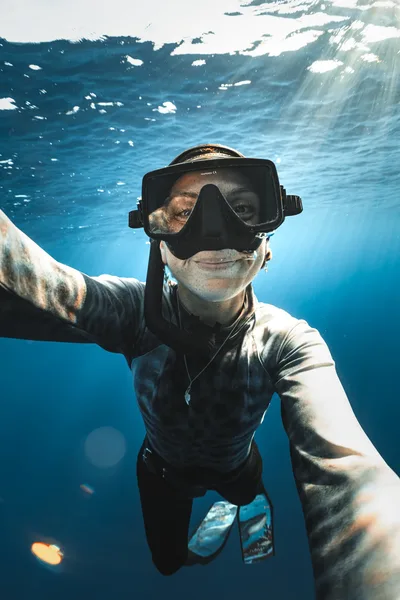
Sina Ritter is a multi-award-winning underwater photographer and co-founder of Liquid Shark Divers Fuvahmulah. Her favorite photographs are of people's faces the moment fear leaves them. Meet the team →