Thresher Shark Diving in the Maldives: The Site Most Divers Don't Know Exists
Everyone tells you to fly to the Philippines for pelagic threshers. They're not wrong — Malapascua is the world's most reliable thresher destination. But Fuvahmulah is quietly the better one, and almost no one is writing about it. Here's why.
Thresher Shark Diving in the Maldives: The Site Most Divers Don't Know Exists
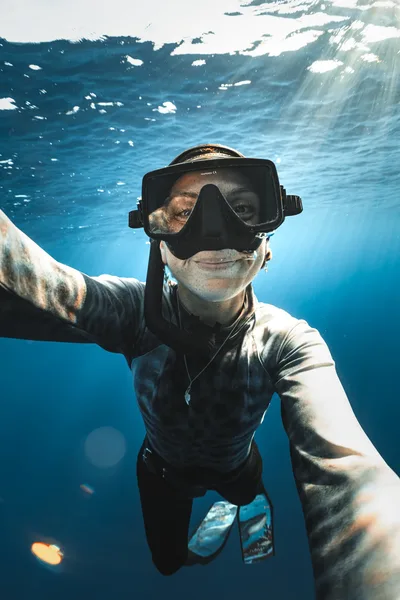
A founder's note from beneath the surface — Sina Ritter, Liquid Shark Divers Fuvahmulah
We´re at Thoondu. The boat is still, the sun isn't up yet, and we're hanging at 25 meters in the blue, breathing as quietly as four people can breathe. My guide raises one hand — slow, palm-down, the "stay low" signal — and I follow his eyeline into the open water beyond the cleaning station.
She comes out of nowhere.
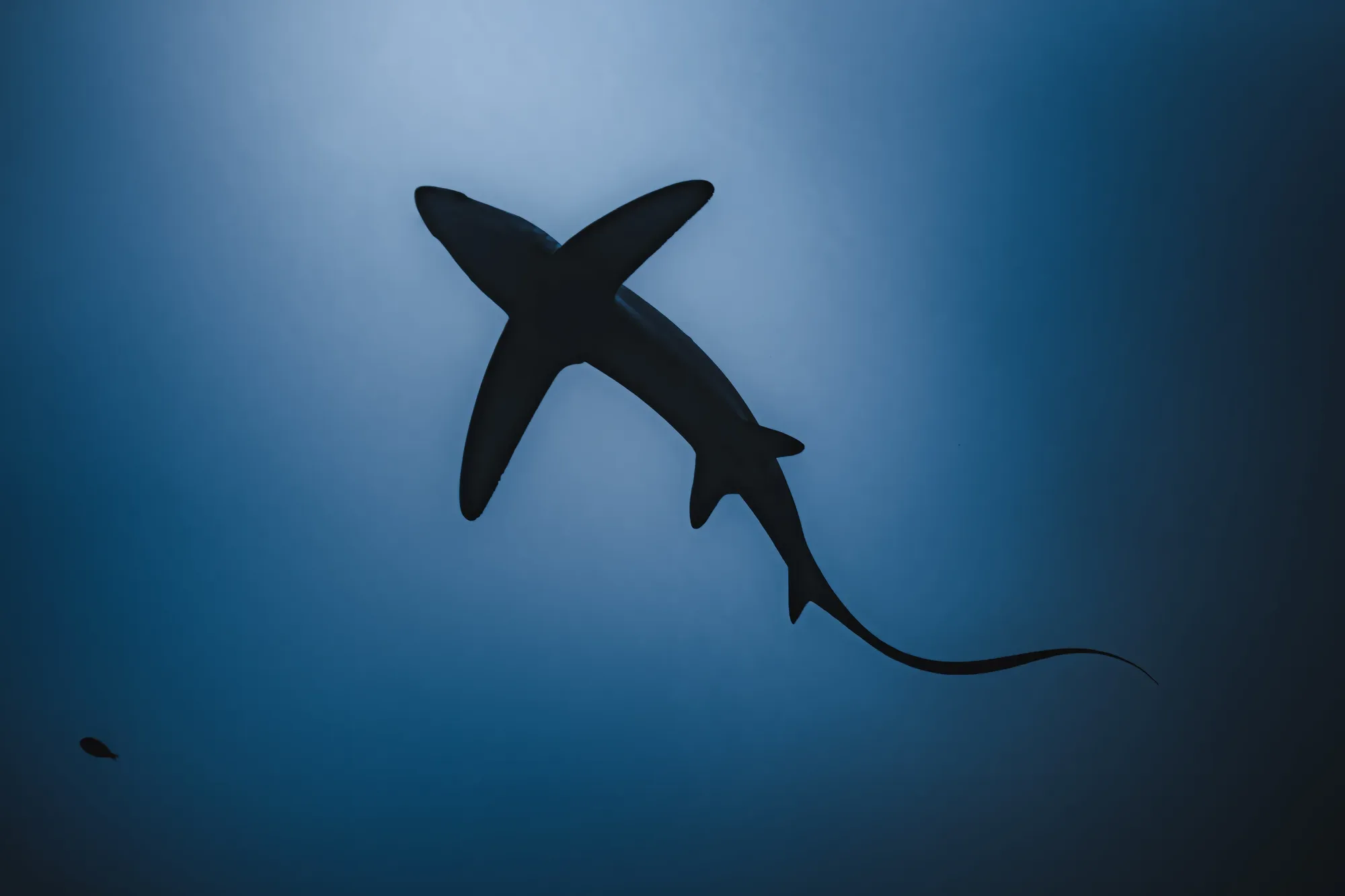
A pelagic thresher, maybe 3.5 meters from tip to tip, with a tail almost as long as her body. She moves like she's underwater in syrup — slow, deliberate, weightless. Her pectoral fins drop. She slows to stall speed. And for ninety seconds, she circles the small cleaner wrasse station beneath us, letting them do their work while we don't move, don't breathe, don't reach for our cameras.
This is thresher shark diving in the Maldives — and almost no one knows it exists.
The myth: "you have to go to the Philippines"
If you've Googled where to dive with thresher sharks in the last decade, you've been told the same thing every time: Malapascua, Philippines. That's where you go. End of conversation.
And that reputation is earned. Malapascua's Monad Shoal is the most famous pelagic thresher site on Earth, and the dive operators there have built something remarkable — daily sunrise dives, famously consistent encounters, an entire tourism ecosystem built around one shoal of cleaning stations.
Let me be honest: Malapascua is the world's most reliable thresher destination. I'm not going to pretend otherwise. If your one and only goal is "I want to see a thresher shark this trip, no exceptions," book Malapascua.
But if you ask me — Fuvahmulah is quietly the better experience. Not the more guaranteed one. But the better one.
Let me explain what I mean.
Why "second-best" is actually a feature, not a bug
Fuvahmulah is the world's second-best place to see pelagic threshers (Alopias pelagicus) on a regular basis. I'm comfortable saying that publicly because it's true, and because the reason it's second rather than first is the same reason I think it's the more meaningful encounter.
Malapascua's Monad Shoal works because thousands of threshers cycle through one predictable cleaning station every single dawn. It's a known address. They show up the way office workers show up to a coffee shop — same time, same place, every day. A bit like our tiger sharks do here in Fuvahmulah.
Fuvahmulah doesn't work that way. Our threshers don't have one Monad Shoal. They use a network of cleaning stations across the island — Thoondu, One Palm, Ambul, Rasgefanno, Farikede, the southern reefs — and on any given dawn dive, you might find them at one of these sites, several of them, or none of them.
That uncertainty is real. We don't oversell it. Some mornings the blue stays empty.
But here's what most divers don't expect: that uncertainty is what makes the encounter feel like a wild encounter instead of a transaction. When she comes out of the gloom at Thoondu and you weren't sure she was going to, the adrenaline is different. The gratitude is different. The shared look you exchange with your dive buddy afterward, back on the dhoni, is different.
Malapascua gives you a thresher. Fuvahmulah gives you a story.
And then it gives you something else Malapascua can't: the rest of Fuvahmulah's ocean. After your dawn dive, you might surface, eat breakfast on the boat, and an hour later be at Tiger Point with a six-meter tigress on the same morning. That doesn't happen anywhere else on Earth.
What you're actually looking at: the pelagic thresher
Let's slow down for a second, because most divers who chase threshers don't fully understand what they're looking at.
The pelagic thresher (Alopias pelagicus) is what divers sometimes call "the unicorn of the diving world." Their upper tail lobe is roughly half their total body length — a 3.5-meter shark has a 1.75-meter tail. They use that tail to hunt, snapping it like a whip to stun small fish before circling back to feed.
Adults reach 3 to 4 meters in total length, weigh 70 to 90 kg, and can live 20 to 30 years. They give birth to live young (ovoviviparous), usually two pups at a time — which is part of why their conservation status matters so much. They don't breed fast. They can't recover fast.
Their eyes are huge — among the largest of any shark species — which is why dawn matters. They hunt in low light. By 10 AM the cleaning station traffic at Thoondu has usually thinned considerably. It depends on the current and other environmental factors as well, obviously - but you're not waking up at 6 AM because we like making you suffer. You're waking up at 6 AM because the threshers are waking up too, and that's when they're willing to be seen.
"When is thresher shark season in the Maldives?" — a more honest answer
This is the question I get most often, and most websites give you a confident, clean answer like "December to April for best clarity."
That answer isn't wrong. But it isn't the whole truth either.
The honest version: threshers are in Fuvahmulah year-round. They're residents of the wider water column around the island, and the cleaning stations they use are active throughout the year. There is no "thresher season" in the way there's a "hammerhead season" (October to April, narrowly defined).
That said, there are timeframes when we tend to see them a little more regularly:
- December through April is the dry season — calmer seas, better visibility (30 to 40+ meters), easier conditions for the kind of slow, controlled dawn dives that thresher encounters require. More reliable, not because the sharks are more present, but because the diving is easier.
- May through September is low season. Those shoulder months bring rougher seas and lower visibility (15 to 25m), but the cleaning stations stay active — sometimes even more active. There are fewer divers on the island, decent conditions, the threshers don´t care about the monsoon — and often the moodier light gives you more atmospheric photographs than peak season ever does.
So when someone asks me when to come specifically for threshers, my real answer is: come when you can come. They're here year-round — though never on demand. Pair it with the rest of Fuvahmulah's calendar — tigers daily, hammerheads in winter, and chances of whale sharks and mantas in summer — and there isn't a bad month.
If you want me to push you toward a window: late February through early April is the cleanest combination of viz + species variety + boat-day reliability. But please don't skip July just because someone told you it's "low season." Some of my best thresher images are from August.
Why small groups matter on this dive (this is the one)
I'm going to be more direct here than I usually am, because this is important.
If you book a thresher dive with a center that runs groups of twelve, fifteen or twenty divers, you will probably not have a good encounter. Not because those centers are bad. Because the math doesn't work.
Threshers tolerate stillness. They do not tolerate fifteen people scattered across a cleaning station, half of them swimming, half of them snapping photos, one of them rising to chase the shark for a better angle. They will leave. They will not come back that dive. You will surface having seen a tail in the distance (if you´re lucky!) and felt the encounter slip away.
At Liquid Shark Divers, we focus on small groups — the smallest on the island. That's not marketing language. That's a constraint. It limits how many people we can take on any given dive, which means we book up faster than centers that pack their boats. But it's the ratio that makes the thresher experience actually work.
If you're looking for thresher shark diving in the Maldives and a center quotes you a "thresher dive" without telling you the group size — ask. Then ask again. The group size is the dive. Everything else is incidental.
Conservation: why this matters more than the photo
The pelagic thresher (Alopias pelagicus) is classified as Endangered on the IUCN Red List. Global populations have declined sharply over the last several decades — bycatch, finning, and unmonitored fisheries are the primary drivers.
The Maldives banned all shark fishing in 2010. That's part of why Fuvahmulah's pelagic populations are as healthy as they are. It's also why we take our conservation approach at LSD seriously enough to talk about it on the dive itself.
A few things we do that I want you to know about before you book:
- Photo-ID contribution. Every clear shot of a thresher our guests capture, we ask permission to add to ongoing photo-ID efforts that track individual sharks across years and across regions. Your photo becomes data.
- Behavioral monitoring. Our guides log encounter behavior, cleaning station activity, and any signs of disturbance. This goes back to the broader Maldivian shark research community.
- No touching, no chasing, no flash on demand. Non-negotiable. A diver who breaks these rules gets one warning, then no more thresher dives that trip. We've sent guests back to shore over this. We will again.
Threshers don't have the brand recognition tigers do. They're more vulnerable, more delicate, and the fact that you get to see one at all is a privilege that depends entirely on how respectfully the dive industry treats them.
If you come dive with us, you become part of that. That's not a marketing line. That's the contract.
Who this dive is for (and who it's not)
Threshers are not a beginner dive. I'd rather tell you that now than have you arrive disappointed.
You'll get the most out of thresher diving in Fuvahmulah if:
- You're certified to Advanced Open Water or higher
- You have at least 30 to 50 logged dives, including deep dives and drift dives
- You're comfortable with a 6 AM departure and a deeper dive profile
- You're patient — the kind of diver who can stay motionless for 20 minutes
- You value the encounter over the certainty
It's probably not the right dive for you (yet) if:
- You're newly certified, or this is your first deep dive
- You struggle with buoyancy in current
- You need "guaranteed" encounters to enjoy a trip
- Early morning dives aren't a thing you'll do happily
If you're not sure, message us before booking and we'll give you an honest answer based on your logbook. We'd rather you come back ready in a year than have a disappointing trip now.
Ready to plan your thresher shark dive? See our 2026 packages and rates →
Frequently Asked Questions
Can you really dive with thresher sharks in the Maldives?
Yes. Fuvahmulah in the southernmost Maldives, has resident pelagic threshers (Alopias pelagicus) that visit cleaning stations year-round. Most divers don't know this because Malapascua in the Philippines dominates the search results, but Fuvahmulah is the world's quiet second address for threshers — regular dawn sightings year-round, never promised — and it pairs the dive with daily tigers plus seasonal chances of hammerheads, mantas, and whale sharks on the same trip.
How does Fuvahmulah compare to Malapascua for thresher diving?
Malapascua is more predictable — Monad Shoal's dawn encounters are famously consistent. Fuvahmulah never promises a sighting, but it offers a wilder feeling, larger individual sharks on average, dramatically fewer crowds, and the ability to combine thresher dives with multiple other shark species in a single trip. Both are world-class. They're different experiences.
What's the best time of year to dive with thresher sharks in Fuvahmulah?
There's no narrow "thresher season" — they're year-round residents. December to April offers the best visibility (30 to 40+ meters) and calmest conditions. May to September has rougher seas but threshers stay active. The "low" season has fewer crowds and good conditions. Bring patience and pick the month that fits your calendar.
What certification do I need for thresher shark dives at Fuvahmulah?
Advanced Open Water minimum, with comfort in deep dives (cleaning stations sit at 15 to 30 meters) and drift conditions. We recommend at least 30 to 50 logged dives. If you're not certain, message us — we'll give you an honest read on your logbook before you book.
Why are small group sizes so important for thresher diving?
Threshers are extremely shy and will leave cleaning stations when divers are too numerous, too noisy, or too active. A group of twelve or fifteen divers makes a successful encounter mathematically unlikely. We focus on small groups specifically because of the thresher protocol that makes those dives work — stay low, stay still, no chasing.
Are thresher sharks dangerous?
No. Pelagic threshers are shy, plankton-and-small-fish feeders and have never been implicated in attacks on humans. The risk on a thresher dive is the dive profile (depth, dawn light, current), not the shark itself.
What conservation status do thresher sharks have?
The pelagic thresher (Alopias pelagicus) is classified as Enda on the IUCN Red List. Populations are declining globally due to bycatch and finning. The Maldives has banned all shark fishing since 2010, which is part of why Fuvahmulah's pelagic populations remain healthy.