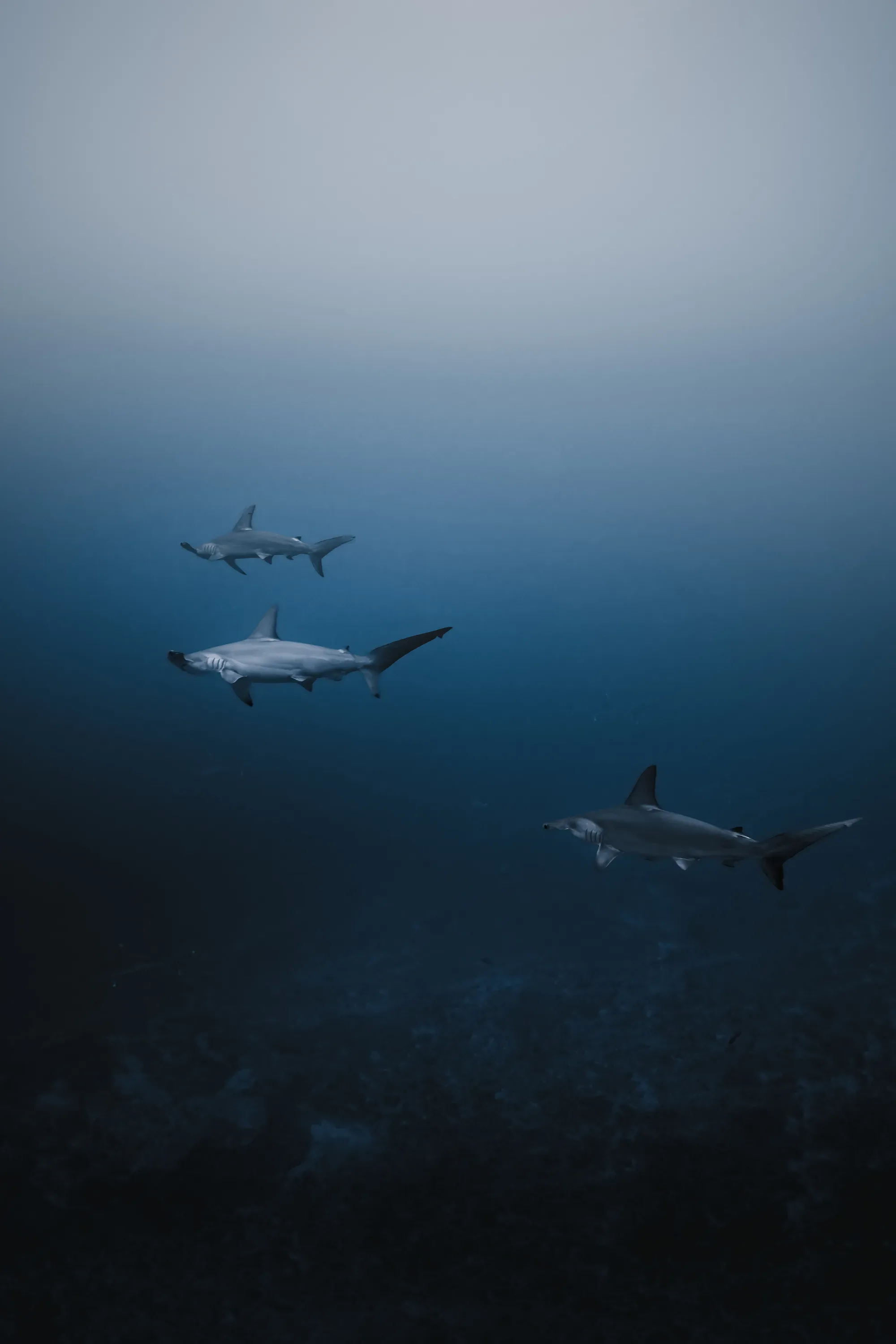
Best Places to Dive with Hammerhead Sharks
The best places to dive with hammerhead sharks range from the Galápagos to the Red Sea — plus one island most lists still miss: Fuvahmulah, where scalloped hammerheads patrol the dawn blue from October to April.
Best Places to Dive with Hammerhead Sharks
The best places to dive with hammerhead sharks range from the schooling walls of the Galápagos and Cocos Island to Bimini's shallow banks and the Red Sea's offshore reefs — plus one island most lists still miss: Fuvahmulah, in the Maldives' deep south, where scalloped hammerheads patrol the dawn blue from October to April. Here's an honest look at where your chances are highest, when to go, and what each destination actually asks of you as a diver.
What makes a hammerhead destination great?
Hammerheads are not tiger sharks. They don't cruise up to the group and make themselves easy. They're shy, sensitive to bubbles, and they tend to hold in deeper, cooler water — which is exactly why seeing them feels like such a privilege. A great hammerhead destination gives you three things: a season when the sharks are known to gather, dive sites where depth and topography bring them within reach, and a team that knows how to put you in the right place at the right hour without chasing the animals away.
Keep that last one in mind as you read. With hammerheads, how you dive matters as much as where.
The best places to dive with hammerhead sharks
Galápagos Islands, Ecuador
The reference point. Darwin and Wolf are famous for schools of scalloped hammerheads, with whale sharks joining in season. It's liveaboard territory — remote, current-swept, cooler water, and best suited to experienced divers. If big-animal diving has a cathedral, this is it.
Cocos Island, Costa Rica
Legendary hammerhead schools around a remote island far off the Costa Rican coast — liveaboard-only, reached by a long open-ocean crossing, with diving possible year-round. The commitment is real — time, budget, sea crossings — and so is the payoff when the schools stack up over the cleaning stations.
Bimini, Bahamas
The great hammerhead capital. In the winter months, these huge, solitary sharks come into shallow, clear water — a very different experience from the deep schooling dives elsewhere on this list, and a favorite with photographers for exactly that reason.
Red Sea, Egypt
Offshore reefs like Daedalus and the Brothers are known for scalloped hammerheads cruising the blue, most reliably in the warmer months. Usually dived by liveaboard, with the schools found by swimming out from the reef into open water.
Rasdhoo Atoll, Maldives
The Maldives entry on most roundups: early-morning dives outside the atoll for a chance at hammerheads in the deep blue. A well-known name — but it's no longer the whole Maldives story.
Fuvahmulah, Maldives
The one the lists keep missing. Fuvahmulah is a lone oceanic island in the Maldives' deep south, surrounded by open water on all sides — no atoll, no lagoon, just drop-offs into the blue. From October to April, dawn dives here offer some of your best chances at scalloped hammerheads, typically at 20–30 meters as they rise from the depths in the early light. Water sits at a comfortable 27–29 °C, so a 3 mm suit is all you need — no liveaboard, no cold thermoclines to suffer through, no week at sea. You sleep in a hotel, the boat leaves the harbour, and you're in hammerhead water within minutes.
And here's what no other destination on this list can say: on the same trip, tiger sharks are part of every single day, with thresher sharks on the dawn roster year-round. Hammerheads are one headline act on an island with several.
When is hammerhead season in Fuvahmulah?
October to April, at dawn. The early start is non-negotiable — hammerheads favor the low light of first morning, and the dives run deep, usually 20–30 meters along the island's walls and points. Our full hammerhead season guide covers the season in detail, and the marine life calendar shows how it overlaps with thresher peak season (December–April) and the whale shark window — which is why the Oct–Apr months book out first.
How hard are hammerhead dives, honestly?
Here's the truth most roundups skip: hammerhead diving is early alarms, blue-water descents, and no guarantees. Some mornings the ocean hands you a school silhouetted against the surface light and you'll never forget it. Some mornings it hands you empty blue — that's wild-animal diving, and anyone who promises you otherwise is selling something. These are deeper dives, so we recommend Advanced Open Water for Fuvahmulah's dive sites beyond the tiger dive, and our briefings are thorough because the setting deserves respect: open ocean, depth, and a shark that rewards calm, quiet divers.
What we can control, we do: every guide on our boats is a certified instructor, we keep a maximum ratio of one professional to three guests on shark dives, and we dive small groups — usually 3–8 divers — because fewer bubbles mean better encounters, for you and for the sharks.
How to earn the encounter
Wherever in the world you dive with hammerheads, the same rules decide whether you get thirty seconds or ten minutes with them. Descend early and quietly — the commotion of a group hitting the water is exactly what sends a school deep. Stay low and together; a tight, calm group reads as background, a scattered one reads as threat. Slow your breathing when the sharks appear, because a burst of excited bubbles is the fastest way to end the show. And never, ever chase — a hammerhead you swim after is a hammerhead you'll only ever photograph from behind. This is the craft our briefings are built around: the dive team's job is to put you in the right place before first light; your job is to become part of the ocean's furniture and let the sharks make the decision. When it works, they come to you — and that moment, a school materializing out of dark blue while the sun is still low, is worth every early alarm of the trip.
FAQ: diving with hammerhead sharks
Where is the best place to dive with hammerhead sharks?
For massive schools, the Galápagos and Cocos are the benchmark — if you have the time and budget for a liveaboard expedition. For great hammerheads in shallow water, Bimini in winter. For hammerhead potential plus daily tiger sharks from one easy island base, Fuvahmulah is hard to beat.
When can you see hammerheads in the Maldives?
In Fuvahmulah, the season runs October to April, on dawn dives at around 20–30 meters. Outside those months, sightings are possible but the odds drop.
Are hammerhead sharks dangerous to divers?
Hammerheads are famously shy around divers — the challenge is getting close, not staying safe. For perspective: Fuvahmulah has never recorded a fatal shark attack.
What certification do I need?
For the deeper dawn dives where hammerheads are usually found, we recommend Advanced Open Water. If you're not there yet, you can complete the course on the island and build it into your trip.
Can you combine hammerheads and tiger sharks in one trip?
In Fuvahmulah, yes — that's the everyday reality here from October to April. Tigers daily, threshers and hammerheads at dawn, all from the same harbour.
Dawn is waiting
If a silhouette of hammerheads in the morning blue is on your list, plan for October to April and give yourself enough mornings to let the ocean deliver. Our dive and stay packages cover flights, hotel and three dives a day — get in touch and we'll help you build the trip around the season.
Liquid Shark Divers is Fuvahmulah's premium shark diving center and creative dive hub — small groups, uncompromising safety standards, and encounters that change how people see sharks. Meet the team →