Small Group Diving: Why We Cap Every Boat, Every Dive
Small group diving means one simple, expensive decision applied everywhere: we would rather sail with empty spaces than dive with a crowd. Capped boats, a 1:3 pr

Small Group Diving: Why We Cap Every Boat, Every Dive
Small group diving means one simple, expensive decision applied everywhere: we would rather sail with empty spaces than dive with a crowd. Capped boats, a 1:3 professional-to-guest ratio on shark dives, and guides — every one of them a certified instructor — who know your name, your air consumption and your camera setup by day two. It's the least scalable way to run a dive center and the only way to run the one we wanted to exist.
This article is the why — because "small groups" is the most copied phrase in diving, and the least often meant.
Reason one: safety doesn't scale
Attention is the raw material of dive safety, and attention divides by headcount. One guide with fifteen divers isn't supervising — they're herding, and hoping.
Our architecture is built the other way: maximum three guests per professional on shark dives, plus dedicated safety divers whose only job is the edges. Every diver inside somebody's attention, every minute. It's the structural reason behind Fuvahmulah's spotless record and ours — and it's non-negotiable in a way a price can't buy off. High season doesn't stretch it. A full inbox doesn't stretch it. It's what you're paying for.
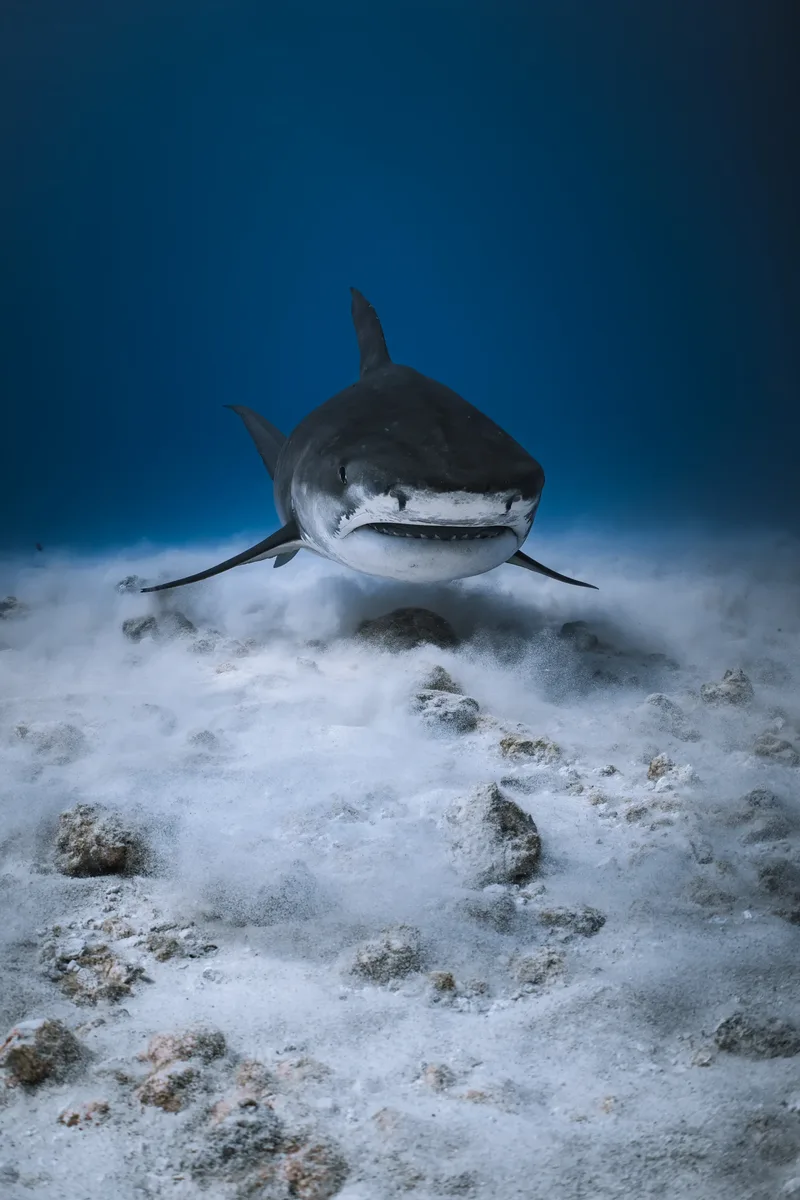
And there's a second safety layer people miss: calm sharks. Twenty divers on the sand changes tiger shark behavior — more bubbles, more chaos, more unpredictability. A small, composed formation keeps the encounter readable for the animals and for us. Small groups aren't just safer for you; they're calmer for the sharks, which makes them safer again.
Reason two: meaningful encounters need room
We exist to create meaningful connections — with the sharks, and with each other. Neither survives a crowd.
With the sharks: a tiger investigating a quiet line of six divers behaves differently than one navigating a wall of twenty. Encounters get closer, longer, more mutual. The moment people travel across the planet for — that eye-contact pass with a known, named tiger shark that rewires a lifetime of fear — is a small-group phenomenon. It needs space and calm to happen at all.
With each other: our boats run on first names. Briefings become conversations, surface intervals become friendships, dinners self-organize. Guests arrive as strangers and leave in group chats that outlast the tan. You can't manufacture that — but you can protect the conditions where it grows, and a capped boat is exactly that.
Reason three: creatives need what crowds destroy
Fuvahmulah attracts photographers, filmmakers and storytellers — and we built the center as a creative dive hub on purpose: founded by a working photographer, staffed by people who understand what a shot needs.
Small groups are the creative infrastructure: room on the sand for a proper camera position without kneeling in someone's frame, guides who'll hold an angle open for your composition, pacing that allows a second attempt at the pass you missed, and evenings where reviewing files together is normal café culture. We cater to creative needs individually — rig space on the boat, dawn scheduling for the light that matters, honest feedback if you want it. Try any of that with nineteen other divers on the schedule.
Every wide, clean, crowd-free shark image you've admired from this island was made possible by someone's decision about boat capacity. That's the invisible credit line under great photographs.
What this means when you book
Practically: our capacity is genuinely finite, and high season sells out — not as marketing pressure, but as arithmetic. Here are the real numbers: our boat has capacity for 21 divers, and we usually sail with 3–8 guests. We only go beyond 15 on rare special requests — a full-boat charter, a film crew — never because the calendar squeezed. When it fills, we say "full" and recommend other dates; we don't quietly add a fourth guest to your guide. It also means every trip gets personal design — your experience level, your goals, your camera, your certification path — because with groups this size, personal care isn't a service tier. It's just how the days work.
If you've dived the cattle-boat version of famous sites, you already know what we're the answer to. If you haven't: protect yourself from ever finding out.
FAQ
How many divers are in your groups? We usually dive with 3–8 guests total, at a maximum of three guests per professional on shark dives — plus dedicated safety divers on every tiger dive. The boat could carry 21; we choose not to fill it, and more than 15 happens only on rare full-boat requests.
Is small group diving worth the higher price? It is the price: ratios, safety divers and instructor-level guides are where the money visibly goes. The full cost breakdown shows the anatomy — you can find cheaper, and it comes with a cost.
Can I book a fully private setup? Yes — private guiding is available ($130/dive), and we regularly build private arrangements for photographers, couples and small crews. Tell us what you're making and we'll shape the water time around it.
Do small groups really matter for photography? More than any lens purchase. Space, patience and repeatable access are the three things crowded boats can't sell — and the three things portfolios are made of.
Want a week where everyone on the boat knows your name by Tuesday? Tell us your dates before the calendar decides for you. Check availability →
Liquid Shark Divers is Fuvahmulah's premium shark diving center and creative dive hub — small groups, uncompromising safety standards, and encounters that change how people see sharks. Meet the team →