Best Camera Settings for Underwater Photography: The Cheat Sheet That Works
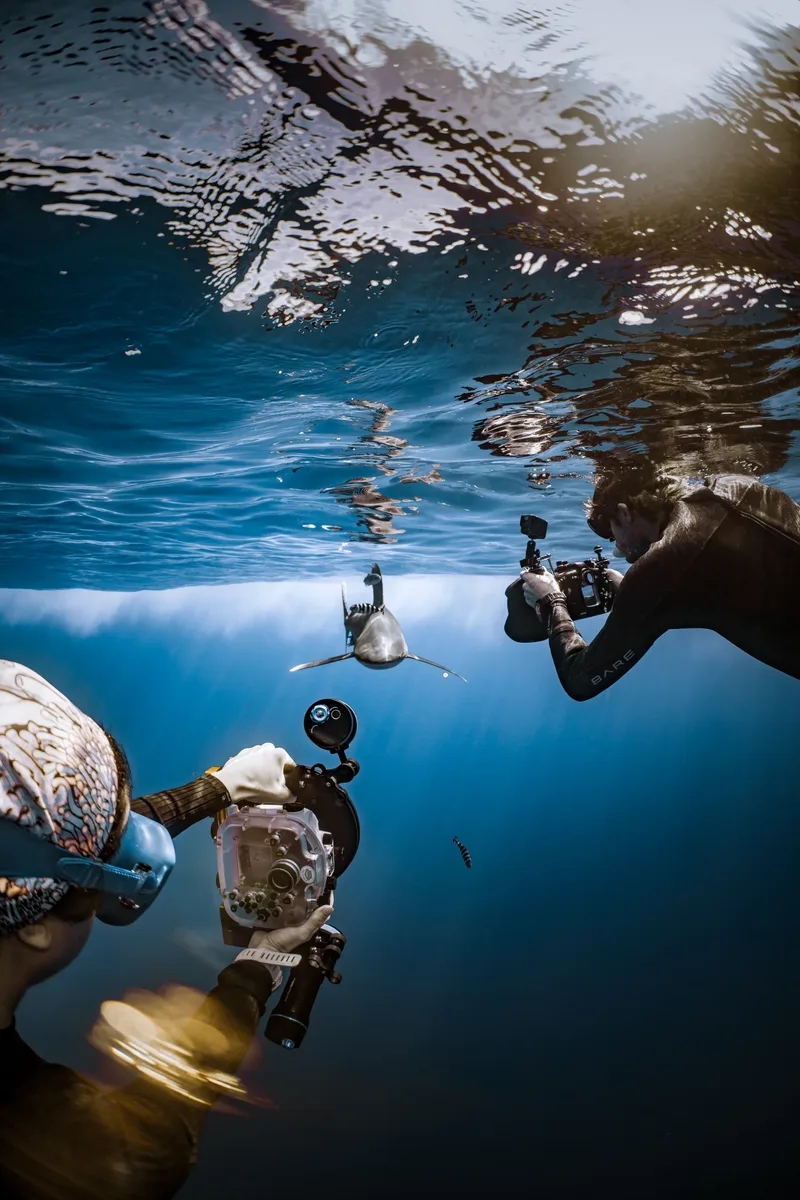
Here's the cheat sheet up front — the starting points I use and teach: wide angle in blue water: 1/200s · f/8 · ISO 400, auto white balance, RAW. Big animals: 1/250s+. Sunbursts: 1/320 · f/11–f/16 · lowest ISO.
Best Camera Settings for Underwater Photography: The Cheat Sheet That Works
Here's the cheat sheet up front — the starting points I use and teach: wide angle in blue water: 1/200s · f/8 · ISO 400, auto white balance, RAW. Big animals: 1/250s+. Sunbursts: 1/320 · f/11–f/16 · lowest ISO. Shallow reef scenes: 1/160 · f/8 · ISO 200. Macro: 1/250 · f/11–f/16 · strobe-dependent. Set those, descend, and adjust from evidence.
Now the part that makes them yours — because settings you understand beat settings you memorized, the moment the ocean changes its mind.
The logic: three dials, one thief
Underwater exposure is the same triangle as land — shutter, aperture, ISO — negotiating with a medium that eats light. Every meter down and every meter of horizontal water costs you brightness and color. So underwater settings are always a trade: enough shutter to freeze motion, enough aperture for sharpness across the frame, and the lowest ISO the first two allow. When light runs short — and it will — sacrifice ISO last for moving subjects, shutter last for still ones. Blur is forever; grain is forgivable and modern sensors barely care until 800+.
Shutter: motion is the boss
- 1/160 — static scenes, reefs, slow subjects in good light
- 1/200–1/250 — the working band: sharks cruising, turtles, anything alive and moving
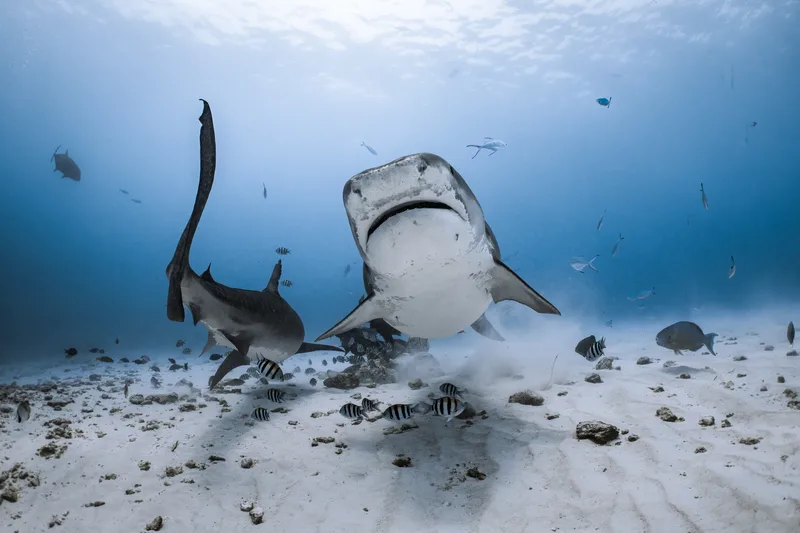
- 1/320+ — fast movers, sunballs, anything at Tiger Harbour doing a close pass
Underwater "slow" is deceptive: a relaxed tiger shark's tail tip moves fast enough to smear at 1/125. When reviewing on the boat, zoom to the eye — if eyes aren't crisp, buy shutter speed with ISO.
Aperture: depth of field is trust
Big animals at close range through a wide lens need f/8–f/11 — you want the whole four meters of shark sharp, not just the snout. Open to f/5.6 only when light forces you (or for deliberate soft-water backgrounds). For macro, f/11–f/16 fights the razor-thin focus zones of close-up work. Corners soft on your wide lens? One stop down usually fixes what the internet blames on the housing.
ISO: the honest modern answer
The old religion of ISO 100-or-nothing died with modern sensors. Base ISO for sunballs and shallow bright sand; 400 as the everyday blue-water default; 800+ without guilt at dawn cleaning stations where the light is cathedral-dim and the thresher won't wait. A sharp ISO 1000 frame beats a blurry ISO 200 frame every single time it has ever been tried.
White balance & RAW: the color rescue
Shoot RAW. This is the least optional setting in underwater photography — it keeps the color data that water stole from your JPEG. With RAW, auto white balance is fine (you'll correct precisely in post). Shooting JPEG only? Custom white balance off your palm or a slate at depth, re-set every few meters of depth change. Filters (red/magenta) help GoPro-style cameras in the 5–15m band.
Focus & drive: the unsung settings
Continuous autofocus (AF-C/Servo) with a flexible zone for animals; single-point for macro. Back-button focus if your rig allows — decoupling focus from shutter changes shark photography. Burst mode: short controlled bursts on passes, not spray-and-pray; you'll thank yourself at review time.
The situational cheat sheet (screenshot this)
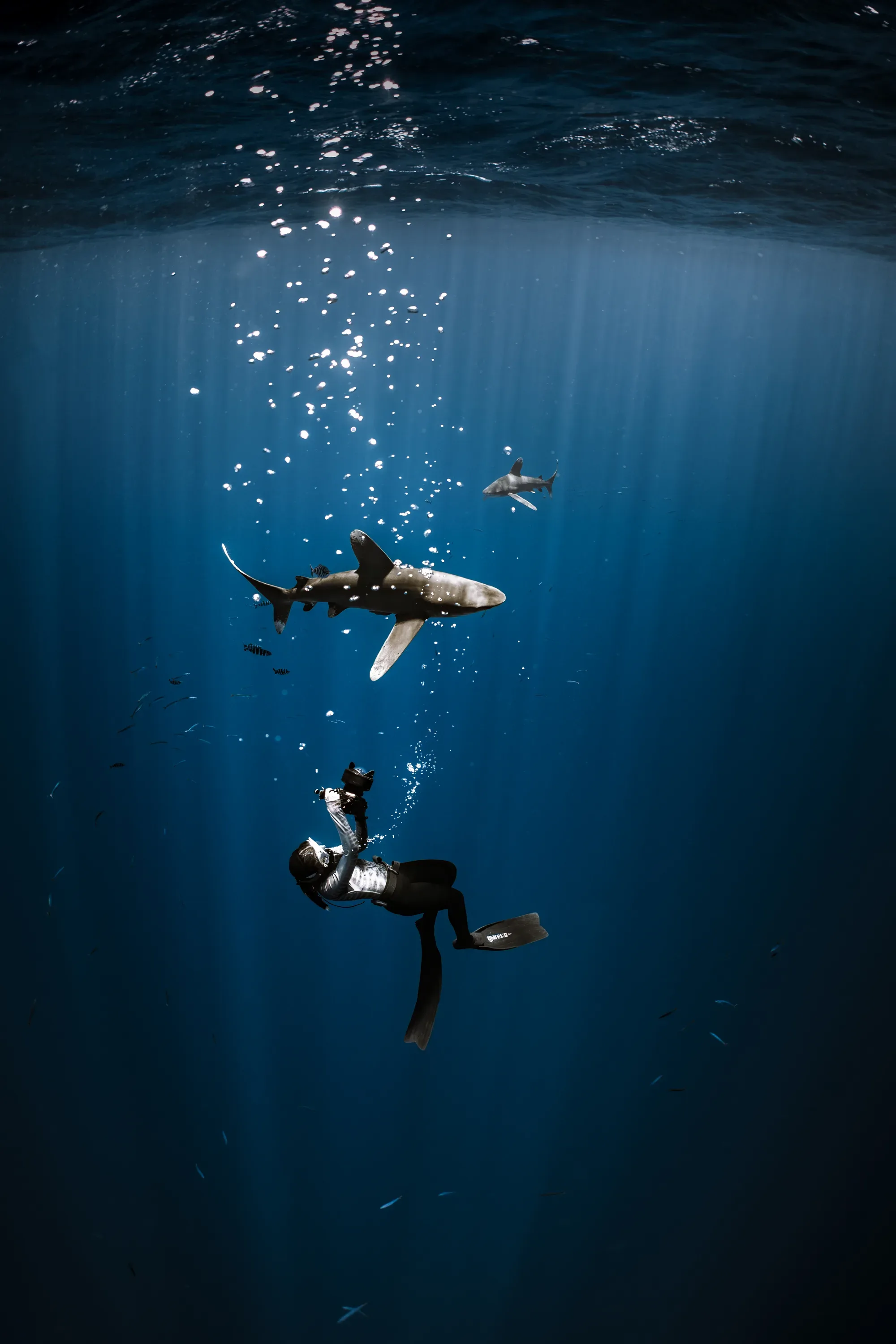
- Blue-water big animal, ambient: 1/250 · f/8 · ISO 400–640 · RAW · AF-C
- Tiger Harbour sand stage (6–8m, bright): 1/250 · f/9 · ISO 200–400 — the most forgiving shark studio on Earth
- Dawn deep (threshers/hammerheads, 20–30m): 1/200 · f/7.1 · ISO 640–1250 — protect shutter, spend ISO
- Sunburst silhouette: 1/320 · f/13 · ISO 100 · expose for the ball, let the diver go black
- Shallow reef color: 1/160 · f/8 · ISO 200, shoot up, get close
- Strobes on: drop ISO one stop, power low, angled out — ambient remains the main light at our depths
Settings are the floor, not the ceiling: buoyancy holds the frame, distance decides clarity, and reading animal behavior decides everything else. That's why this is a series, not a listicle.
FAQ
What's the best all-round underwater setting if I only remember one? 1/250 · f/8 · ISO 400 · RAW · continuous AF. It'll get a keeper from 80% of recreational dive situations; adjust from there with intent.
Why are my underwater photos blurry even at fast shutter speeds? Usually distance (too much water = haze mistaken for blur) or focus mode (single-shot AF losing moving subjects). Halve your distance, switch to continuous AF, and re-test before blaming the camera.
Do these settings work for phones and compacts? The logic transfers completely — prioritize shutter (sports mode if no manual), lock focus, shoot the highest quality format offered, get close, shoot up. We rent full underwater cameras ($120) if you want to test real controls.
Auto mode — is it really that bad? Auto meters for a world with land light and picks slow shutters underwater. Even one manual dial (shutter priority at 1/250) transforms results overnight.
Want these settings drilled into muscle memory next to a professional — on subjects that deserve them? That's a mentorship week. Bring any camera; leave with your own cheat sheet, written in experience. Ask me about it →
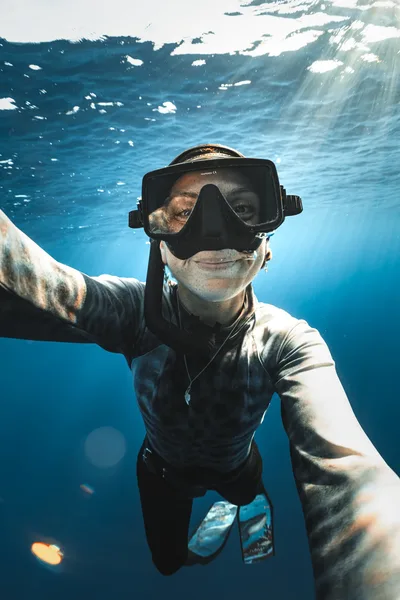
Sina Ritter is a multi-award-winning underwater photographer, SSI Photo & Video instructor, and co-founder of Liquid Shark Divers Fuvahmulah. Her settings are a starting point; her patience is the actual secret. Meet the team →