How to Photograph Sharks: The Field Guide From a Thousand Shark Dives
Photographing sharks well requires five things in a fixed order: calm diving, close distance, low position, fast-enough shutter, and the ability to read what the animal will do three seconds from now.
How to Photograph Sharks: The Field Guide From a Thousand Shark Dives
Photographing sharks well requires five things in a fixed order: calm diving, close distance, low position, fast-enough shutter, and the ability to read what the animal will do three seconds from now. Notice that only one of the five is a camera setting. I've built my career photographing sharks — tigers, threshers, hammerheads, oceanic species — and this is the complete field method, the one I teach in the water here in Fuvahmulah.
This is the pillar guide of our photography series: beginner fundamentals, camera settings and GoPro setups went before; consider this where they all point.
Rule zero: the diver makes the photograph
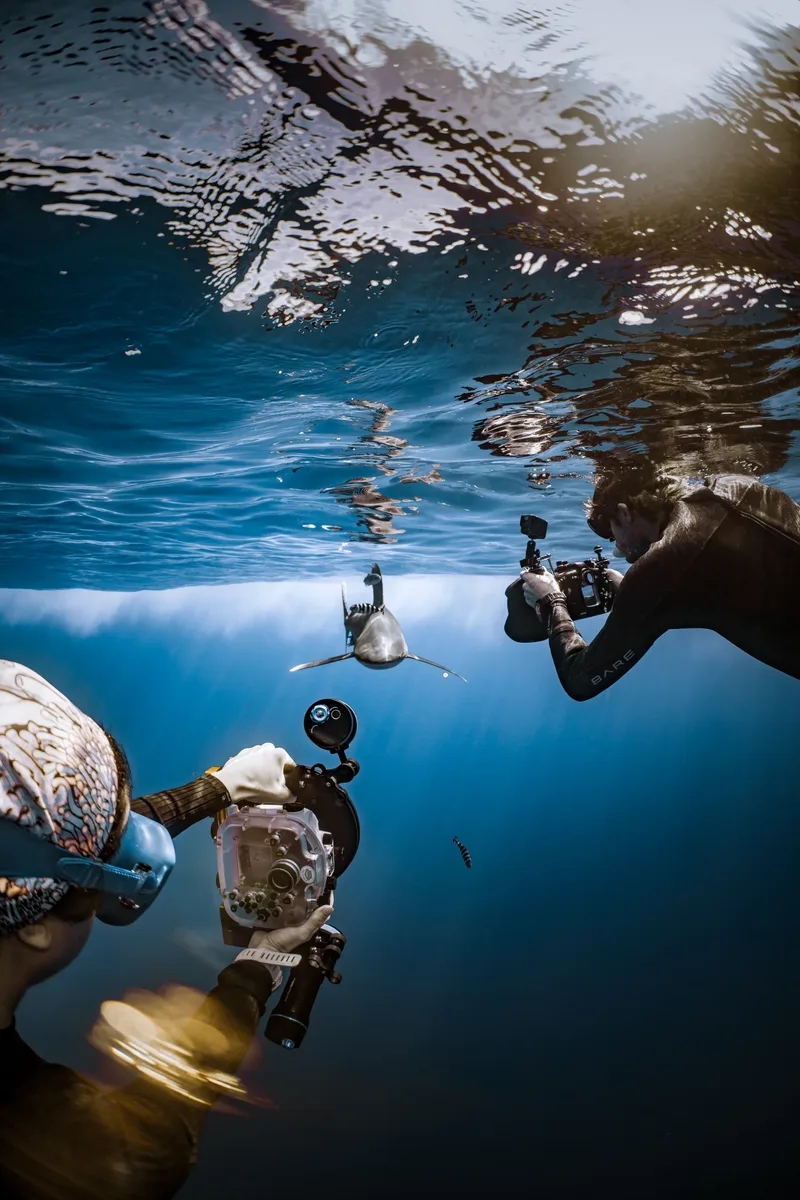
Sharks photograph divers before divers photograph sharks — they read your breathing, posture and intent from far outside your visibility. A tense, chasing, vertical diver empties the water. A calm, low, grounded diver becomes part of the seascape — and the sharks come closer, longer, more often.
So the brutal, liberating truth: your shark photography ceiling is your diving. Buoyancy that holds a frame motionless, breath control that doesn't spook, and total fluency in the safety protocol — these are photography equipment. The camera is downstream.
The settings (brief, because they're the easy part)
Starting points in blue water: 1/250s · f/8 · ISO 400 · RAW · continuous AF, shutter up to 1/320 for close passes, ISO up without fear in dawn gloom. Wide-angle lens, always — if the shark doesn't fill the frame, you're not close enough yet, and no focal length fixes distance through water. The full settings logic lives here; memorize the starting points, then stop thinking about menus underwater.
Position: where shark photographs come from
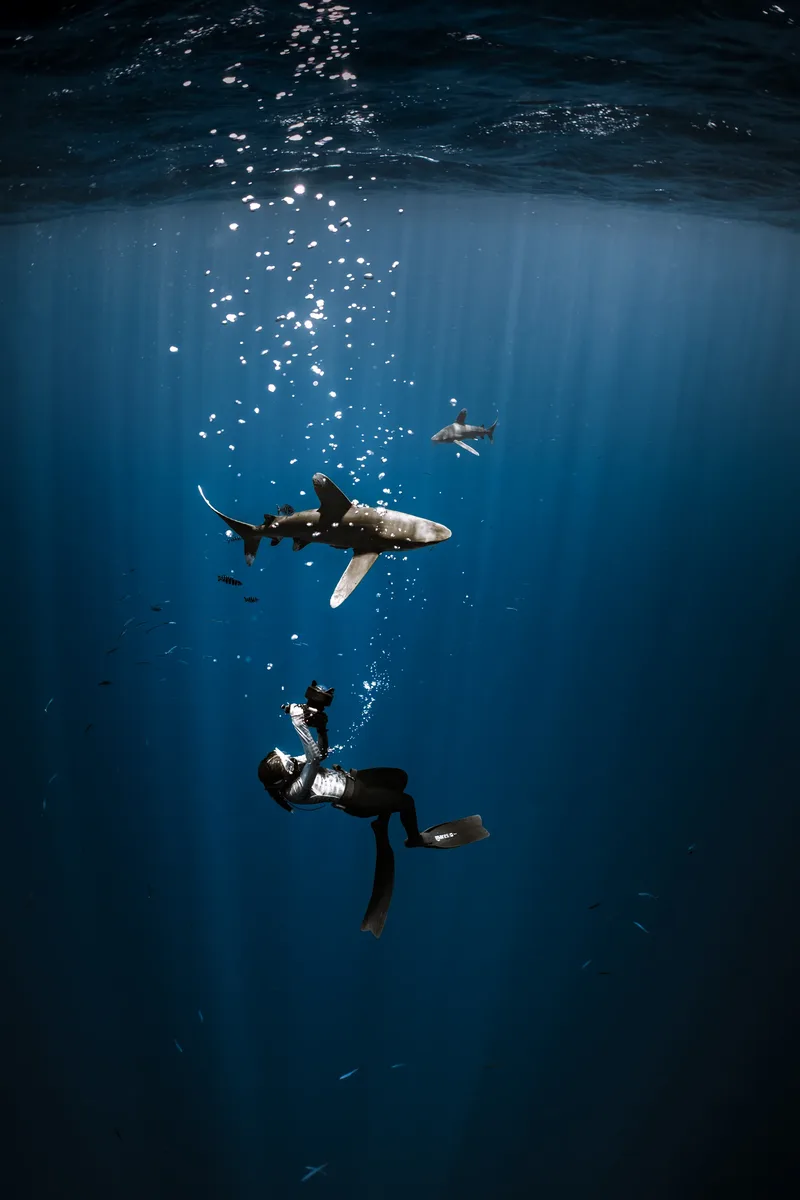
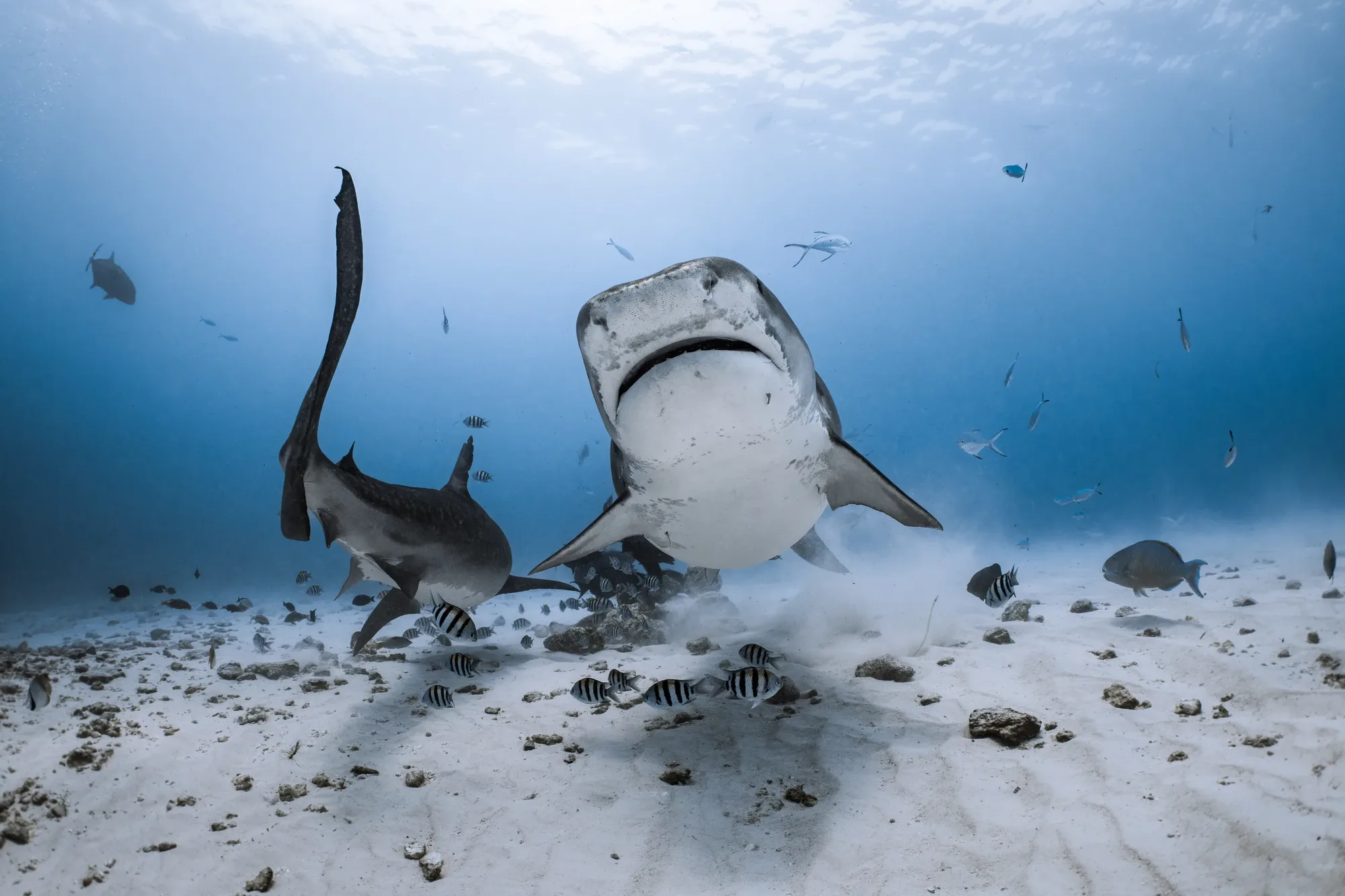
Low, or lower. Chest to the sand, lens at or below the shark's eyeline. Shooting up sets the animal against light and scale; shooting down produces gray fish on gray bottom. Every memorable shark image you've ever admired was made from below the subject's midline — check; I'll wait.
Angles, not chases. You cannot out-swim a shark and you shouldn't try — movement toward an animal is pressure, and pressure ends encounters. Instead, position where the shark is going: read the arc, settle at its far end, and let four meters of tiger shark swim into your composition. Hunting with patience instead of fins is the entire craft.
The eye is the photograph. Focus point on the eye, always. A tack-sharp eye with motion-soft fins is a portrait; a sharp tail with a soft eye is a deletion. And when the eye meets the lens — that flicker of mutual awareness — you have the frame that stops scrollers mid-thumb.
Reading behavior: the three-second future
This is what separates field guides from settings lists. Sharks telegraph:
The committed arc — steady speed, consistent line: it will pass where the line says. Pre-frame there.
The investigation — slowing, pectorals angling, a curve tightening toward you: a close pass is coming. Hold position, hold nerve, shoot the approach and the turn — the turn, fins flared, is often the picture.
The disengage — acceleration, line straightening away: done with you. Lower the camera, reset, watch the blue for the next entrance.
Species change the rhythm: tigers are slow, confident investigators — the most generous models in the ocean. Threshers are shy dawn ghosts — stillness and low light discipline. Hammerheads school at depth and punish impatience. Learning one resident population deeply — which is what this island uniquely offers — teaches you to read them all.
Light: ambient first, strobes as seasoning
At Tiger Harbour's 6–8 meters, ambient light does the heavy lifting — one reason this is the best shark photography classroom on Earth. Strobes, when you add them: low power, angled outward, for eye-light and stripe detail — never to nuke the scene flat. Deep and dawn: protect shutter, spend ISO, embrace mood. Sunball silhouettes: stop down, expose for the light, let the shark go graphic black. Three looks, one island, often one single day.
Ethics: the non-negotiable chapter
No baiting manipulation for a shot, no blocking an animal's path, no touching, no crowding, protocol above portfolio — always. Not only because it's right: respect is visible in photographs. Images made calmly, at the animal's choosing, carry a quality viewers feel before they can name it. The photographers whose shark work changed public perception — the work this island's conservation story depends on — all shot this way. Trophy-hunting with a camera produces trophies; patience produces portraits.
FAQ
What do I need to photograph sharks? A wide-angle capable camera, solid buoyancy, a professionally run shark dive, and patience. In that order of importance — truly.
How close do you get to sharks for photos? You don't "get" close; you make yourself calm and available, and sharks choose closeness. At Tiger Harbour, passes within 1–2 meters are routine for composed divers in formation.
Is flash/strobe use harmful to sharks? Low-power strobes used respectfully show no evidence of harm and are standard practice; blasting repeated full-power flash at close-approaching animals is poor etiquette everywhere and not tolerated on our dives.
Where is the best place in the world to photograph sharks? I'm biased and correct: Fuvahmulah — the only place with daily year-round tiger sharks plus real chances of threshers, hammerheads and oceanic mantas in the same week, at depths where ambient light still works. The comparison with Tiger Beach is here.
Ready to learn this in the water instead of a browser? My mentorships run from one day to a full week — settings to behavior-reading to editing, with the world's most reliable tiger shark models. Ask me anything →
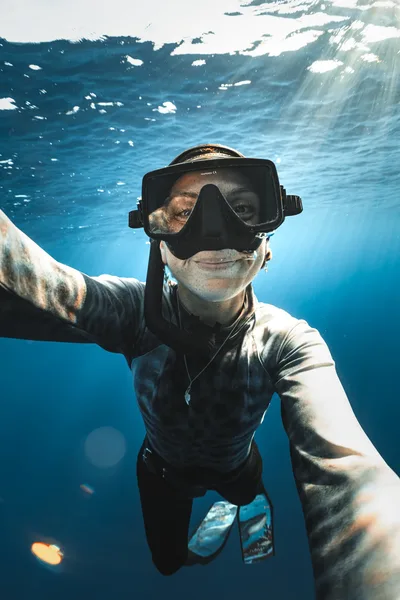
Sina Ritter is a multi-award-winning underwater photographer, SSI Photo & Video instructor, and co-founder of Liquid Shark Divers Fuvahmulah. The sharks of this island have posed for her more than anyone alive. Meet the team →