Ethical Shark Diving: What It Actually Means — and How We Do It
Ethical shark diving comes down to verifiable practices, not vibes: non-live natural bait only, never hand-feeding, never cages, small groups that don't crowd th
Ethical Shark Diving: What It Actually Means — and How We Do It
Ethical shark diving comes down to verifiable practices, not vibes: non-live natural bait only, never hand-feeding, never cages, small groups that don't crowd the animals, strict no-touch protocol, trained professionals in the water, and money that demonstrably supports shark protection. That's the checklist. This article unpacks each item, honestly — including the parts of the debate that deserve straight answers — and shows exactly where we stand on every one.
Because "ethical" has become diving's most decorative word, and the sharks deserve better than decoration.
The honest question first: is provisioned shark diving ethical at all?
Let's take the hardest question head-on instead of hiding it in an FAQ.
Yes — provisioning (using bait scent and reward to structure encounters) changes shark behavior at the site: it creates a reliable meeting point. Critics are right about that, and pretending otherwise is dishonest. Here's the rest of the picture: research on Fuvahmulah's tigers shows they continue their normal wide-ranging hunting and travel — provisioning here concentrates where you meet them, not what they are. Sharks have been protected in Maldivian waters since 2010, and encounter tourism is a large part of why that protection holds politically and economically: a living shark on this island is worth incomparably more than a landed one, year after year.
So our position: provisioned encounters are ethical when the method is restrained and the money protects sharks — and unethical when either fails. Which makes the how everything:
How we provision — the exact standards
Non-live, natural bait only. Locally sourced fish waste from the island's tuna culture — the same food source that drew these sharks for generations. Nothing lives to be used, nothing artificial enters the water.
Never hand-feeding. No gloved handler theatrics, no shark taking food from a human. The association we allow is "this place sometimes smells interesting" — never "humans give me food." That line protects the sharks' wildness and every future diver's safety, and we hold it absolutely.
Minimal and consistent. Enough to structure a calm encounter; never a frenzy, never a show. Same procedure, same choreography, every day — predictability is welfare, for animals and humans alike.
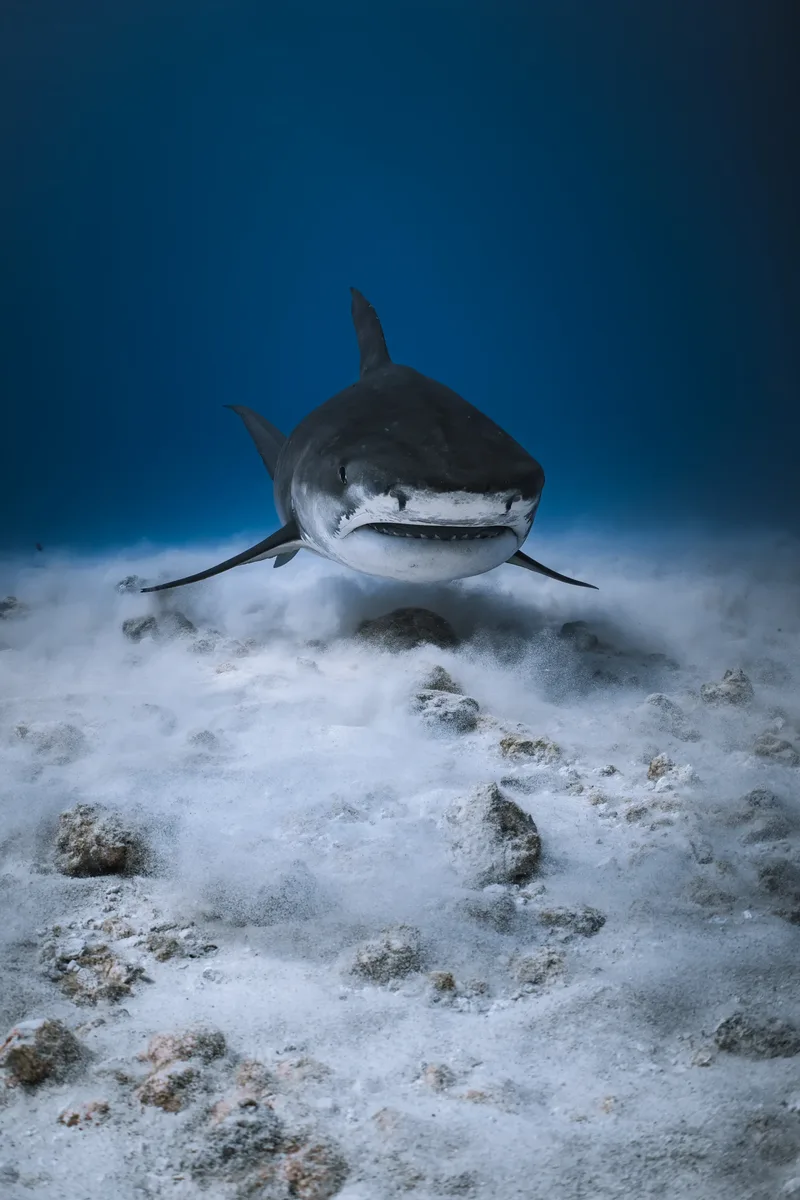
No cages — because respect works better than bars. Cage-free is Fuvahmulah's model: understood animals, controlled diver behavior, professional supervision. Bars teach spectacle; open water at eye level teaches respect. One of these changes how people treat sharks for the rest of their lives.
The rest of the ethics checklist
Small groups. Crowds stress animals and erode protocol. Our boats are capped, ratios fixed at 1:3 with dedicated safety divers on every tiger dive. If you remember one screening question for any operator on Earth: how many divers do you put on the encounter?
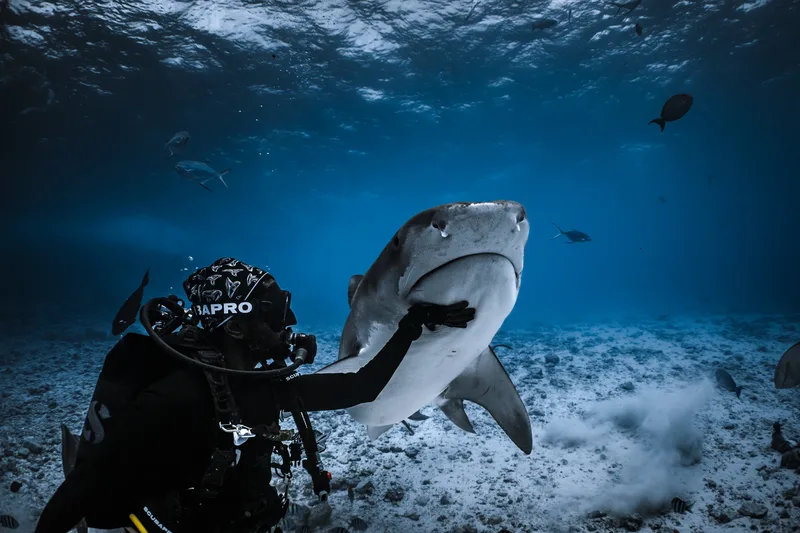
No touching, no chasing, no blocking. Ever. Passive observation is the entire sport. Any operator who bends this for content is selling the sharks out — walk away.
Professionals, not just guides. Every guide on our team is a certified instructor, trained to read individual animals and to end any dive that stops meeting the standard. Ethics without enforcement is a brochure.
Education built in. Guests leave shark-literate, not just shark-photographed — briefings that teach behavior, a full SSI Shark Ecology course for those who want depth, and conservation commitments we publish and keep.
Contribution beyond the dive. Photo-ID contributions to research, support for the science documenting this population, and a business model whose entire existence argues — in the language economies understand — that these sharks are worth more alive.
How to vet ANY shark operator (take this with you)
Five questions that expose everything: What bait, and is it ever live? (Only acceptable answer: non-live, natural.) Is there ever hand-feeding? (No.) How many divers per encounter, and what's the ratio? (Small, fixed, staffed.) What happens when a guest breaks protocol? (The dive ends or they do.) Where does conservation show up in your operation — specifically? (Named practices, not adjectives.)
Operators who welcome these questions are the ones worth your money. We answer all five in writing, before you book, happily.
Why this matters more every year
Roughly 100 million sharks are killed by humans annually; a third of shark and ray species are threatened. Encounter tourism done right is one of the few forces that flips the economics — but only done right earns that defense. Every crowded, hand-feeding, protocol-free shark circus hands ammunition to the people who'd rather see this industry banned than reformed.
We run our dives so that the strongest argument for shark protection in the Maldives is the look on our guests' faces at the surface. That's the standard. It doesn't bend for a busy season, and it's the reason the right guests find us.
FAQ
Is shark diving ethical? It can be — with non-live bait, no hand-feeding, no crowding, strict protocol, and revenue that supports protection. It can also fail every one of those tests. The variable is the operator, not the concept.
Do you feed the sharks by hand? Never. Non-live, natural bait, minimal and controlled — no hand-feeding, no shows. The sharks stay wild; that's the whole point.
Does baiting make sharks dangerous to swimmers elsewhere? The research on Fuvahmulah's population shows normal ranging and hunting behavior maintained — and the island's record across decades of this culture is zero fatal attacks. Managed protocol is precisely what prevents problem associations from forming.
How do I know an "ethical" operator is actually ethical? Ask the five questions above and demand specifics. Ethics you can't verify is marketing.
Want to see what respected sharks look like? Come dive the standard — and hold us to every word of this article while you're here. We'd genuinely love that. Talk to us →
Liquid Shark Divers is Fuvahmulah's premium shark diving center and creative dive hub — small groups, uncompromising safety standards, and encounters that change how people see sharks. Meet the team →