Fuvahmulah vs Tiger Beach: An Honest Tiger Shark Comparison
If you want to dive with tiger sharks, two names dominate the conversation: Tiger Beach in the Bahamas and Fuvahmulah in the Maldives. The short version: Tiger B
Fuvahmulah vs Tiger Beach: An Honest Tiger Shark Comparison
If you want to dive with tiger sharks, two names dominate the conversation: Tiger Beach in the Bahamas and Fuvahmulah in the Maldives. The short version: Tiger Beach is a legendary, shallow, bait-structured encounter with big Atlantic females, best October–January, usually via liveaboard. Fuvahmulah is the world's largest documented tiger shark aggregation — 200+ individuals — available every day of the year, from an inhabited island, alongside regular dawn threshers, seasonal hammerheads and oceanic mantas.
Both are world-class. They are also profoundly different trips. Having spent my career photographing sharks across the world's great sites, here's the comparison I give friends when they ask — with the respect both places deserve.
The two heavyweights, side by side
- The encounter — Tiger Beach: Baited hang on white sand, ~6m · Fuvahmulah: Managed encounter on sand plateau, 6–8m
- Sharks per dive — Tiger Beach: Often several big females · Fuvahmulah: 4–10 typical, 15+ on great days
- Season — Tiger Beach: Best ~Oct–Jan · Fuvahmulah: Year-round, daily
- Population — Tiger Beach: Famous returning individuals · Fuvahmulah: 200+ documented individuals (largest known aggregation)
- Other big species — Tiger Beach: Lemons, reef sharks, occasional hammerhead · Fuvahmulah: Threshers, hammerheads, oceanic mantas, whale sharks, silvertips
- Base — Tiger Beach: Mostly liveaboard, some day boats from Grand Bahama · Fuvahmulah: Inhabited island — hotels, cafés, real life
- Getting there — Tiger Beach: Flights to Bahamas + boat · Fuvahmulah: Flights to Malé + 1 domestic hop
- Typical cost — Tiger Beach: Liveaboard weeks commonly $3,500–5,500+ · Fuvahmulah: Packages $1,250–3,635 incl. domestic flights & stay
- Water — Tiger Beach: Atlantic — cooler edges of the season · Fuvahmulah: Indian Ocean, 27–29°C always
- Photography — Tiger Beach: White-sand studio light · Fuvahmulah: Blue-water drama, walls, variety
Now the parts a table can't hold.
What Tiger Beach does brilliantly
Credit where it's massively due: Tiger Beach built the world's love affair with tiger sharks. Those luminous white-sand images — huge females over bright bottom, tiger stripes in turquoise — created modern shark photography's most iconic look, and changed public perception of the species forever.
The site's shallow, controlled setup produces long, close encounters with genuinely large animals, and the operators there pioneered protocols the whole industry learned from. For a photographer chasing that specific white-studio aesthetic, Tiger Beach remains the address. It has mystique for a reason, and anyone who tells you otherwise is selling something.
So why do more and more shark divers — including many Tiger Beach veterans — point their next trip at a small island in the Indian Ocean?
What Fuvahmulah changes
The calendar disappears. Tiger Beach has a season. Fuvahmulah's tigers are resident — 200+ documented individuals, the largest aggregation science has recorded — and the dive runs every day of every month. Your trip fits your life, not a weather window.
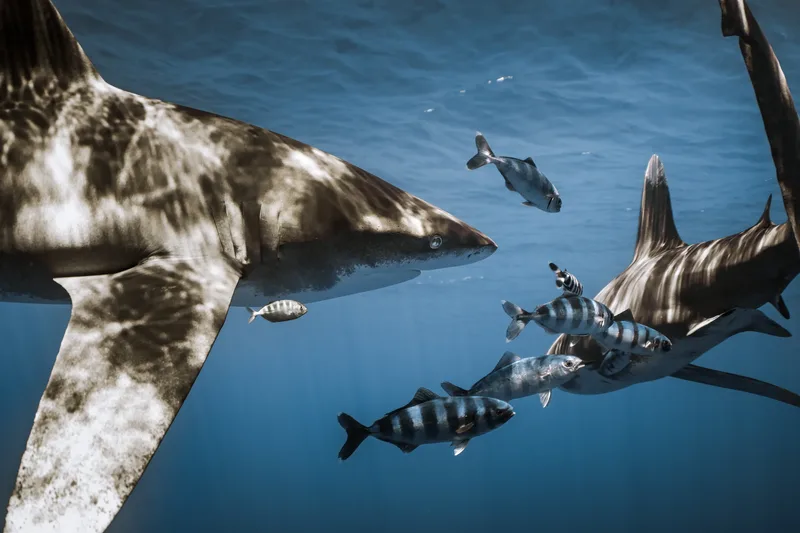
One dive becomes a whole ocean. At Tiger Beach, tigers are the show. Here, they're the headline act of an ensemble: dawn thresher sharks, hammerhead schools October–April, oceanic mantas in spring, whale shark chances — the full calendar — often in the same day as your tiger dive. There is nowhere else on Earth where a tiger dive is the second most surprising thing that happened before lunch.
Land under your feet. Tiger Beach is a boat trip; Fuvahmulah is a place. You sleep in a hotel, walk to dinner, meet the island whose story the sharks belong to. It changes the emotional shape of the trip — from expedition to visit.
The economics. A Tiger Beach liveaboard week commonly runs $3,500–5,500 before flights. Our all-in packages — stay, domestic flights, 3 dives daily — run $1,250 to $3,635 total. The Indian Ocean asks a longer flight of most travelers and returns the difference several times over.
The style of encounter. Both sites use provisioning; the philosophy differs. Tiger Beach's classic format is a static baited hang. Fuvahmulah's protocol is a managed, minimal, tightly choreographed encounter — structured enough for safety, restrained enough that what you watch still behaves like a wild animal passing through its ocean.
For the photographers
Tiger Beach gives you the white studio: even light, clean sand, subjects at close range doing predictable passes. It's forgiving and iconic — you will come home with the shot, and so has everyone else.
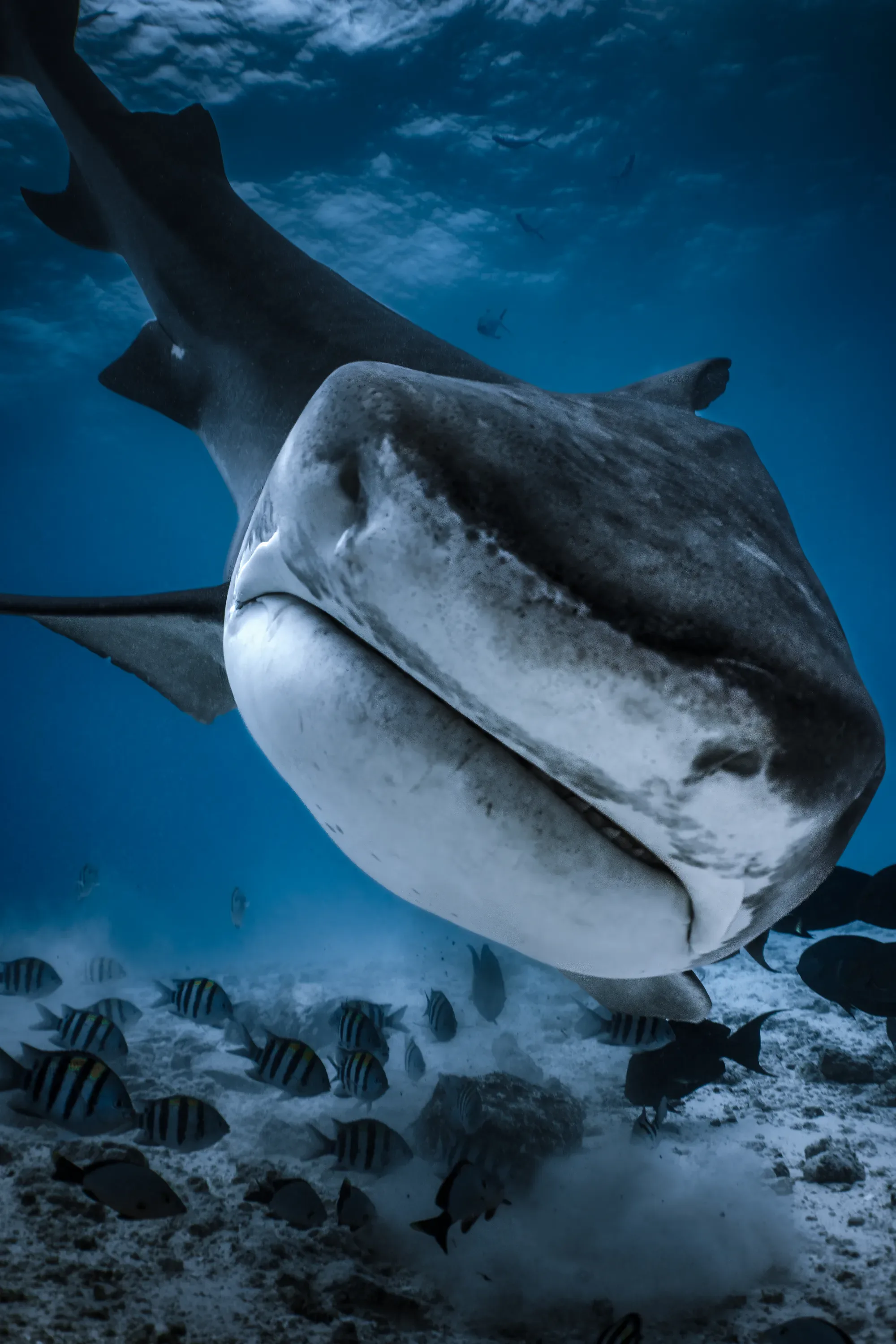
Fuvahmulah gives you range: sand-plateau portraits at 7 meters, blue-water drama on the walls, dawn threshers in cathedral light, and enough species to fill three portfolios. It demands a little more and repays it with images fewer people on Earth have. My own answer to "which one" is the fact that I built my life here.
FAQ
Which is better, Tiger Beach or Fuvahmulah? For the classic white-sand tiger aesthetic and Atlantic big females: Tiger Beach. For year-round certainty, the world's largest documented aggregation, multi-species days and island-based cost efficiency: Fuvahmulah. "Better" depends on which trip you're dreaming of — both are world-class.
Where are the sharks bigger? Tiger Beach is famous for very large females; Fuvahmulah's residents run 3–4.5m with real giants among the 200+. Honestly: past four meters, your nervous system stops keeping score.
Which is safer? Both destinations have strong records under professional protocols. Fuvahmulah's island-wide record — zero fatal shark incidents, ever — and its small-group, safety-diver culture are something we've written about openly.
Can I combine sharks with a "normal" holiday in Fuvahmulah? Yes — that's the point of an inhabited island. Non-diving partners, culture, cafés, beaches: it's a destination, not only a dive site.
Done the Bahamas and ready for the wilder chapter — or choosing your first tiger destination? Tell us where you're at; we'll give you the honest version for your trip, even when the answer is "do both." The Fuvahmulah tiger dive, in full →
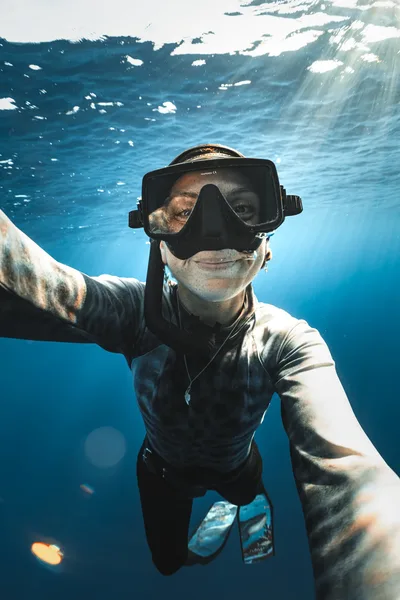
Sina Ritter is a multi-award-winning underwater photographer and co-founder of Liquid Shark Divers Fuvahmulah. She has photographed tiger sharks across the world — and chose one island to stay. Meet the team →